MENA News
ARABSAT and Es’hailSat Partner to Expand Arab Broadcast Reach

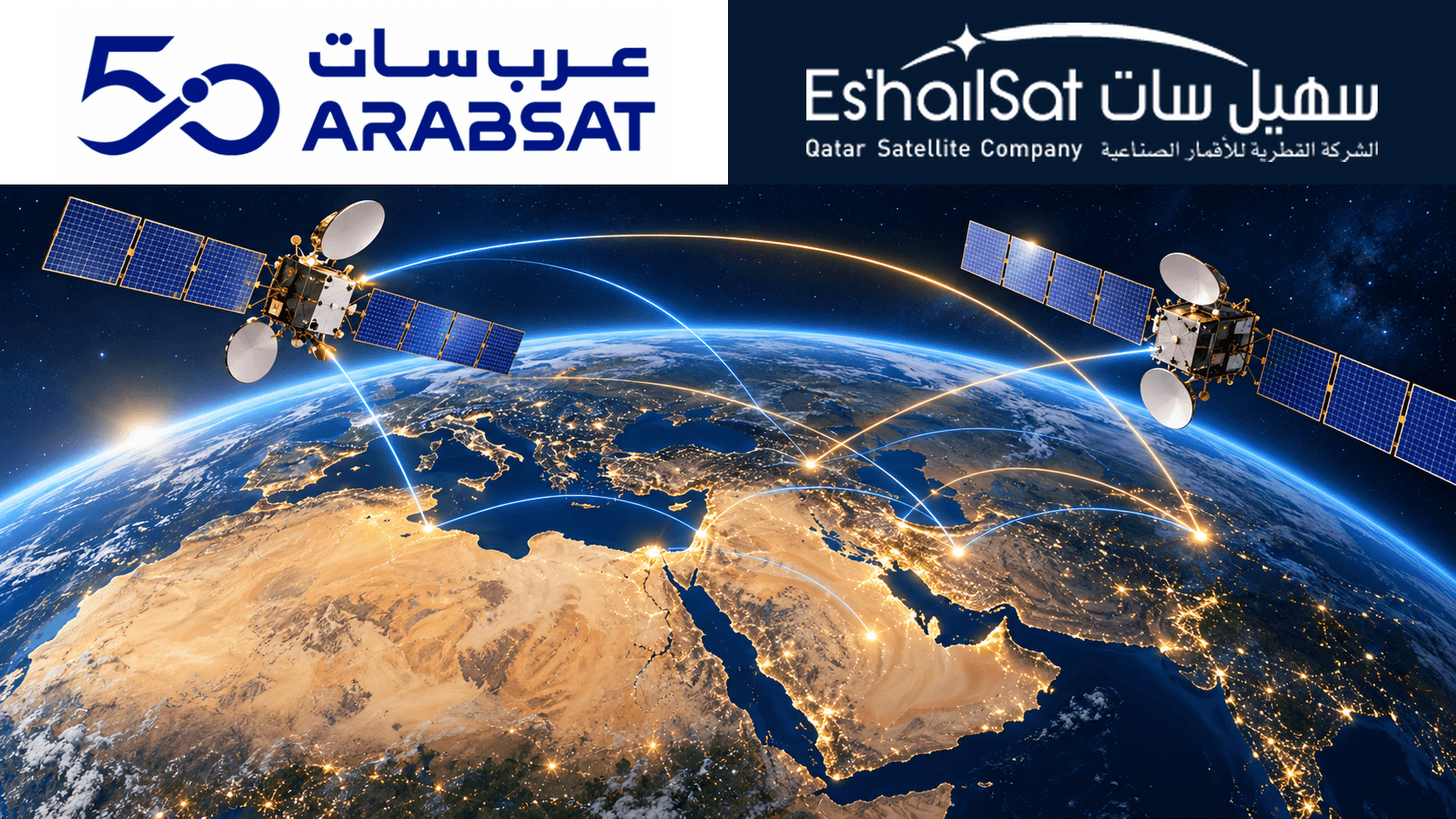
The agreement covers the 26° East broadcast hub, satellite connectivity and distribution of Arab channels beyond MENA.
[For more news, click here]
Arab broadcasters need reliable regional distribution and routes to viewers overseas. Satellite operators support both through the capacity in orbit and the ground facilities that prepare and transmit channels.
ARABSAT and Es’hailSat, the Qatar Satellite Company, signed a strategic partnership agreement during the Arab Radio and Television Festival in Hammamet, Tunisia. The agreement brings regional broadcasting, international channel distribution and satellite connectivity into a framework for long-term cooperation between the two operators.
A central objective is to strengthen the 26° East orbital location as a broadcasting hub by increasing the number of channels and broadening the content available across the Middle East and North Africa. The companies also plan joint initiatives that draw on their respective infrastructure and expertise.
Building on the regional broadcast hub
Es’hailSat already operates at 25.5° and 26° East. Its direct-to-home services allow viewers across MENA to receive television through small satellite dishes. The company's Doha teleport also provides channel playout, compression, encryption, uplink and distribution, connecting the preparation of programs on the ground with their delivery by satellite.
Cooperation at this location has an earlier foundation. Es’hailSat's official timeline records a strategic agreement with ARABSAT in 2013 to expand broadcasting opportunities at the 26° East television neighborhood. The latest announcement places that same hub alongside cooperation in international content distribution and connectivity.
The new agreement will also expand cooperation on the Unified Arab Bouquet, using international satellite coverage to distribute Arab channels beyond MENA. This gives the partnership two related priorities: developing the regional viewing offer and extending the reach of Arab content to audiences in other markets.
Badr N. Alsuwaidan, CEO of ARABSAT, said:
“Through this cooperation, we look forward to reinforcing the 26° East orbital location and expanding areas of cooperation in broadcasting, communications, and satellite connectivity solutions, while supporting the global reach of Arab content and enabling it to reach wider audiences worldwide.”
The emphasis on 26° East follows ARABSAT's September 2026 announcement of ARABSAT-50, a planned high-power Ku-band satellite to be manufactured by China Great Wall Industry Corporation. ARABSAT said the spacecraft is designed to support continuity of direct-to-home television at that orbital position and provide flexible backup capacity across its fleet.
ARABSAT-50's design also allows adjustments to beams and channel frequencies as operational requirements change. For broadcasters, the planned flexibility and backup capacity are intended to support service continuity as their distribution requirements evolve.
Expanding the connectivity relationship
The agreement extends beyond television to VSAT services and other connectivity solutions. VSAT networks use small satellite terminals to connect separate locations, serving customers such as businesses and government organizations. ARABSAT and Es’hailSat plan to explore technologies that improve service quality, efficiency and reliability while offering more integrated services.
Es’hailSat has separately been expanding its connectivity plans. On June 30, 2026, it announced a partnership with Türksat and a manufacturing contract with Thales Alenia Space for Es’hail-3/Türksat-Biruni. The planned high-throughput Ka-band satellite is intended for 50° East, a separate orbital location from the broadcast hub covered by the ARABSAT agreement.
That satellite is designed to adjust coverage and bandwidth to customer demand, with planned applications including enterprise networks, maritime connectivity and remote communications. Its intended coverage spans MENA, Europe, Central Asia and Sub-Saharan Africa. The project illustrates the wider connectivity business alongside Es’hailSat's established television distribution services.
For broadcasters and connectivity customers, the partnership establishes a basis for coordinated services, with its practical reach depending on the joint projects the operators develop under the agreement.