Startups
MWC26 Doha Brings AI, Connectivity and Digital Policy Together

The Qatar event will examine AI deployment, 5G revenue and digital policy alongside the opening of ITU's global policy conference.
For more news, click here
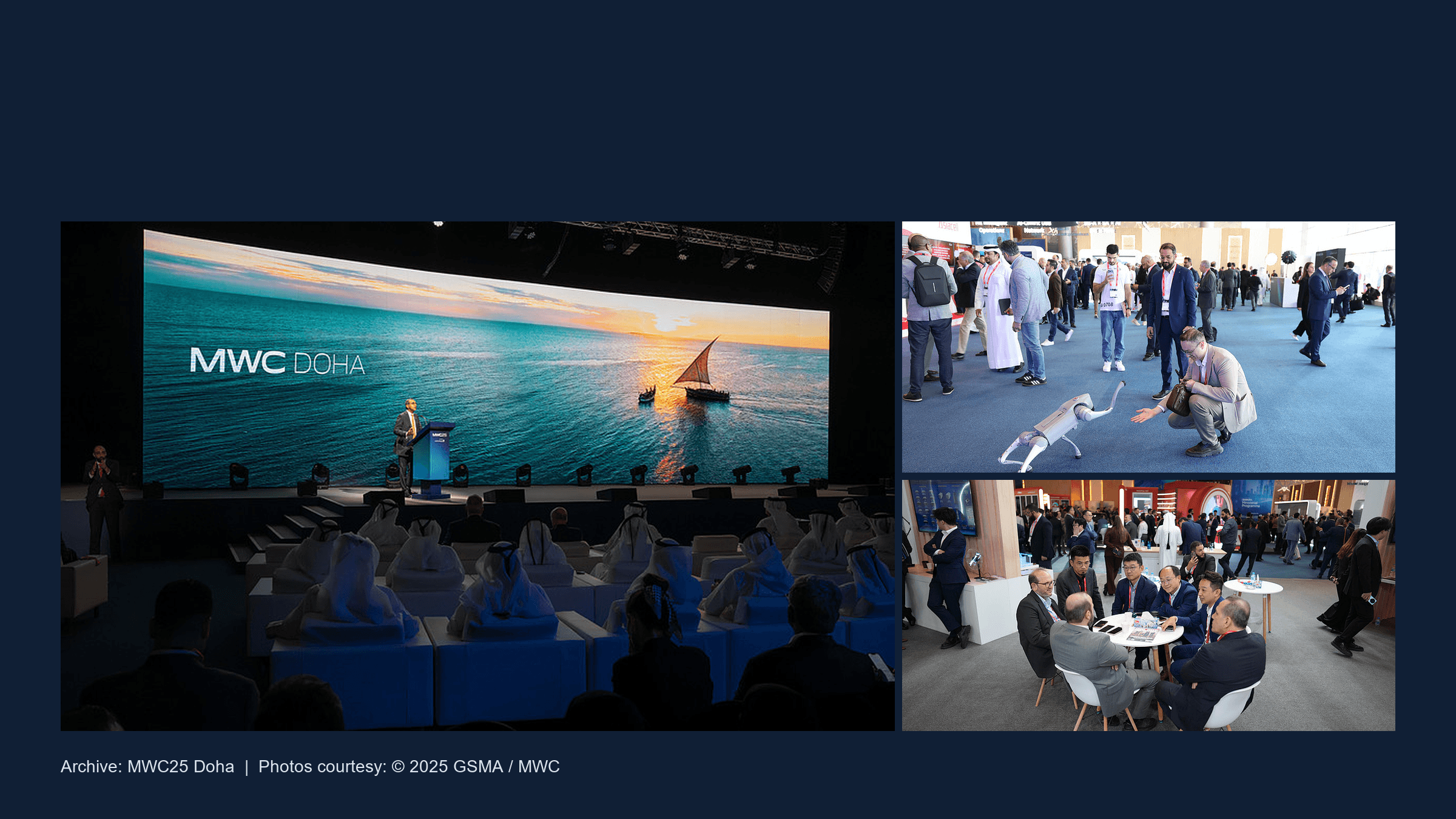
Scenes from MWC25 Doha. Photos courtesy: © 2025 GSMA / MWC. Layout: Tech Revolt.
AI deployment and the search for new revenue from 5G are bringing telecom strategy closer to enterprise and government priorities. Those questions will shape MWC26 Doha as it returns to Qatar this month.
The event's exhibition floor is sold out, according to the organizer's November 4 announcement. It runs November 8-10 at the Doha Exhibition and Convention Centre. General attendee registration remains open.
Organized by GSMA in partnership with Qatar's Ministry of Communications and Information Technology, MWC Doha brings together telecom operators, technology companies, investors and policymakers. This is its second edition. GSMA reported almost 9,500 unique attendees from 110 countries and territories at the 2025 debut.
AI and network services
Eight dedicated summits will examine the technologies and policies behind MENA's digital economy. Their scope extends from the infrastructure needed to run new services to the governance of AI systems used in business and government.
The Sovereign AI & National Digital Strategy Summit will cover national capabilities across data, infrastructure, regulation and talent. The Agentic AI Summit will examine autonomous agents in enterprise operations, networks and customer engagement. Governance and human oversight are part of that discussion.
AI in Action will focus on organizations deploying AI at scale for productivity and automation. Open Telco AI will provide a technical showcase of AI developed for telecommunications. Together, these sessions connect national AI ambitions with the practical work of deploying and operating the technology.
The Future Networks Summit will address 5G Standalone, cloud-based network architecture and preparations for 6G. The Satellite & NTN Summit will examine satellite commercialization, including direct-to-device services and integration with terrestrial mobile networks. Revenue strategies and spectrum are also on its agenda.
Security and Smart Mobility complete the summit program. They will cover telecom threats and intelligence sharing, alongside autonomous vehicles, advanced air mobility and AI-powered transport.
Confirmed exhibitors include Ooredoo, Vodafone Qatar, Google Cloud and Microsoft. Their participation places network operators and cloud technology providers on the same exhibition floor as the conference examines how their services can work together.
Industry and policy in the same venue
MWC26 Doha will share its venue with the opening days of the International Telecommunication Union's Plenipotentiary Conference, or PP-26. Running November 9-27, that conference sets ITU's general policies, adopts strategic and financial plans, and elects its leadership. The overlap brings the commercial program alongside a separate global policy process.
The GSMA Ministerial Programme returns with closed-door meetings, exhibition tours and discussions involving government and industry leaders. On the first day, the Digital Leadership Forum will address policy, regulation and investment priorities for inclusive digital transformation. MCIT is supporting the forum, with ITU participating.
MCIT also plans a Qatar Pavilion bringing together more than 15 government and semi-government entities, according to Qatar News Agency. It will showcase national work in AI, digital government and innovation, linking the exhibition to Qatar's Digital Agenda 2030.
The program also includes work developed before the exhibition. GSMA says the MENA Ignite Hackathon attracted more than 1,500 participants from Arab League countries and Türkiye. Across seven challenge themes, 63 teams produced working prototypes using AI agents to coordinate several CAMARA application programming interfaces, which give software access to network capabilities.
Three winning teams have been invited to demonstrate their solutions in Doha. An overall winner is due to be announced on November 9.
The hackathon gives the event a practical example of developers building on telecom infrastructure. Alongside the AI summits and policy discussions, it puts the focus on how connectivity can support services used by businesses and the public. Turning those prototypes and discussions into sustained commercial use remains the work beyond the exhibition.