Deep Tech
NVision’s Molecular Qubit Opens a New Route to Quantum Chips

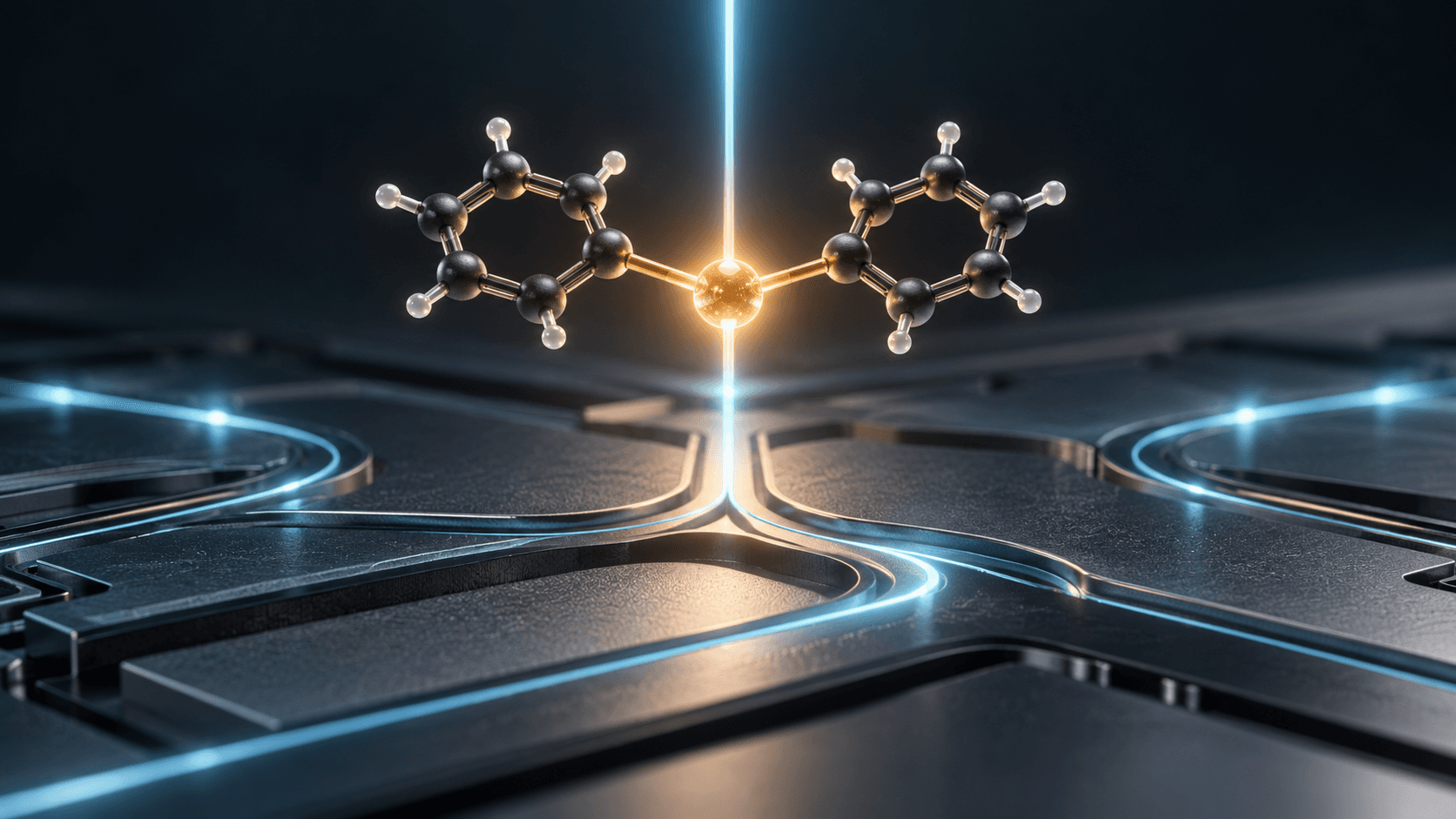
The Nature findings offer a molecular building block for connected quantum chips, with manufacturing and large-scale operation still to be demonstrated.
[For more news, click here]
Quantum computers process information using the quantum behavior of particles such as atoms and electrons. They could help scientists simulate molecules and materials that are difficult for conventional machines to model, supporting research into medicines and industrial chemicals. Reaching that potential, however, means overcoming the fragility of the information these machines use.
Useful systems need large numbers of reliable, connected qubits, the basic units of quantum information. Their states are easily disturbed, and adding more qubits makes controlling and connecting them harder. German startup NVision has demonstrated a molecular building block that could help address that challenge.
In research published in Nature on October 28, NVision and academic collaborators showed that an engineered organic molecule can hold quantum information while interacting with light. That combination makes it a candidate for future processors whose qubits communicate through optical links.
A molecule designed for the job
The molecule stores information using electron spin, a quantum property with magnetic behavior. In NVision’s experiment, laser light prepares and reads the spin, while microwave pulses manipulate it. A closely matched crystal helps protect the molecule from disturbances.
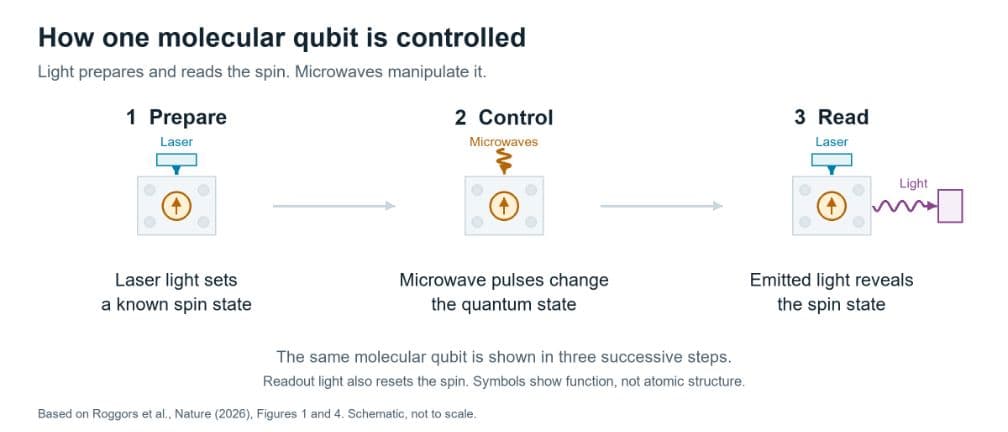
How one molecular qubit is prepared, controlled and read. Original schematic based on Roggors et al., Nature (2026), Figures 1 and 4. Not to scale.
The company says finding the right combination took about four years of computational screening and laboratory work. Chief technology officer Ilai Schwartz described the outcome in an interview with Reuters:
“We found this ‘Goldilocks’ molecule.”
Many earlier molecular experiments measured groups of molecules together. Single-molecule spin detection also predates this study, but bringing individual control, persistent spin states and stable optical behavior together has been the challenge.
NVision combines precise control of an individual molecule with stable optical behavior and a useful spin in its lowest-energy configuration. The information-bearing spin therefore does not depend on keeping the molecule excited, and individual control lets researchers operate qubits separately.
Protective microwave pulses extended the measured coherence time, which describes how long quantum-state relationships survive, to about 2.2 milliseconds. The experiment required cooling to approximately minus 269 degrees Celsius.
The significance extends beyond that measurement. Chemical design gives researchers a way to adjust a molecule’s behavior and synthesize copies with the same atomic structure. It could help them develop qubits suited to the chips and connections a larger machine needs.
Taking the next step onto chips
NVision has announced a partnership with HyperLight to integrate molecular material onto photonic circuits, chips that guide and control light. The company is targeting an on-chip demonstration by the end of 2026.
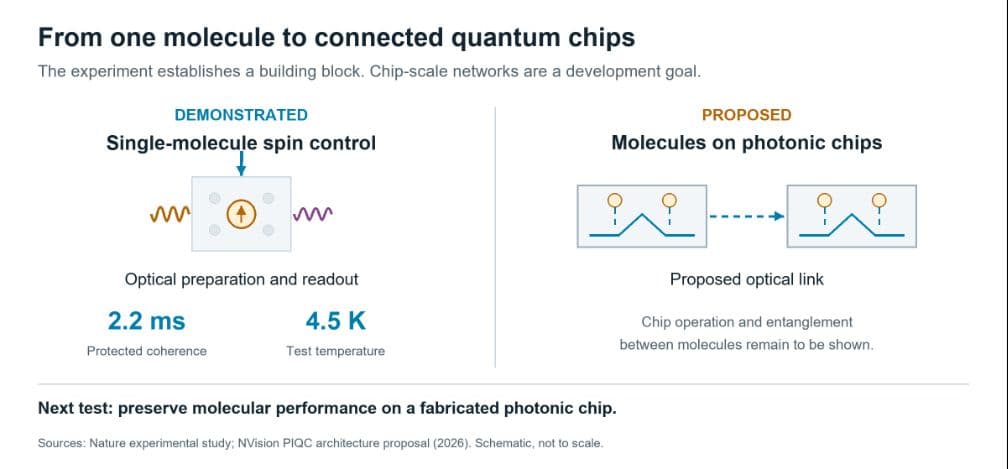
Demonstrated molecular control and proposed chip integration. Original schematic based on the Nature study and NVision architecture proposal. Dashed links indicate development goals.
If successful, this approach could combine repeatable molecular synthesis with established photonic manufacturing. Quantum systems could grow through connected chips, giving the industry another route to producing and linking large numbers of qubits.
The Nature paper demonstrates the molecular building block. NVision’s proposed architecture still requires the molecules to retain their performance on chips and become entangled, sharing quantum states that allow them to work together. Reliable error correction and consistent manufacturing would also be needed for practical computing.
The advance gives molecular quantum hardware a stronger foundation: researchers can now build on a demonstrated combination of control, stability and optical interaction. This demonstrates industrial promise, bringing us one step closer to physical, practical quantum computers.