AI
ServiceNow Expands EmployeeWorks With No-Code AI Agents and ToolSmith


ServiceNow is expanding EmployeeWorks with no-code AI assistants, automated workflows, and ToolSmith, a developer environment trained on more than 75,000 APIs. The new capabilities aim to help employees automate tasks across enterprise applications while maintaining organizational controls.
For more news, click here
Enterprise AI is moving beyond answering questions and generating content toward completing tasks across business applications. However, building AI agents that can access company data, interact with existing systems, and carry out work securely often requires developer support, creating a gap between employees' automation needs and the tools available to them.
ServiceNow is expanding its EmployeeWorks platform to address that challenge, allowing employees to create and customize AI agents without writing code. The update introduces Productivity Assistants for role-specific work, Productivity Routines for recurring tasks, and ToolSmith, an agentic development environment designed to simplify the creation of enterprise AI tools.
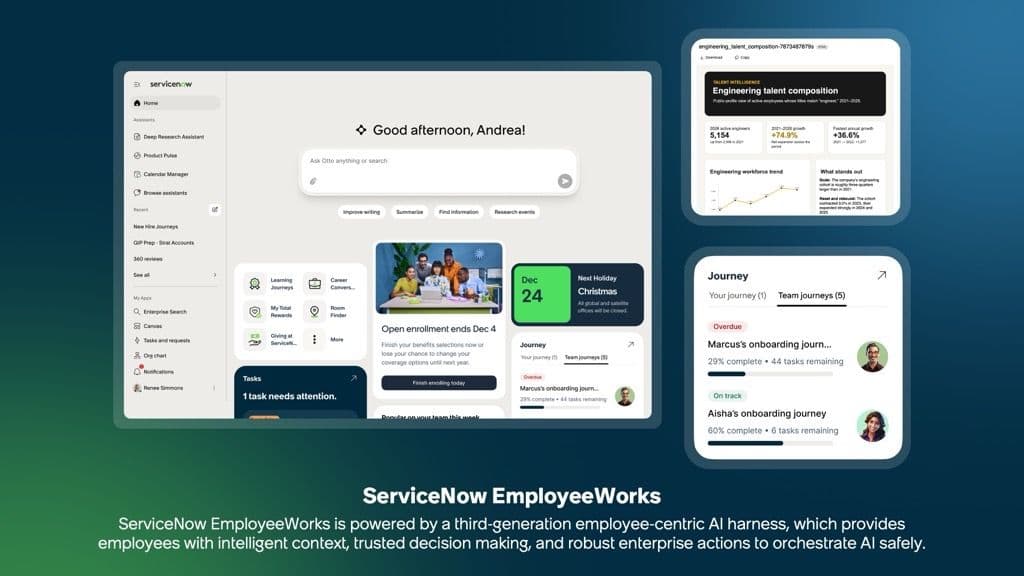
The capabilities run on ServiceNow's third-generation employee-centric AI harness, which combines reasoning, memory, and tool interoperability. The system is designed to help AI agents understand employee requests, maintain context, and carry out actions across connected business applications while operating within organizational permissions and controls.
AI Assistants Built Around Employee Roles
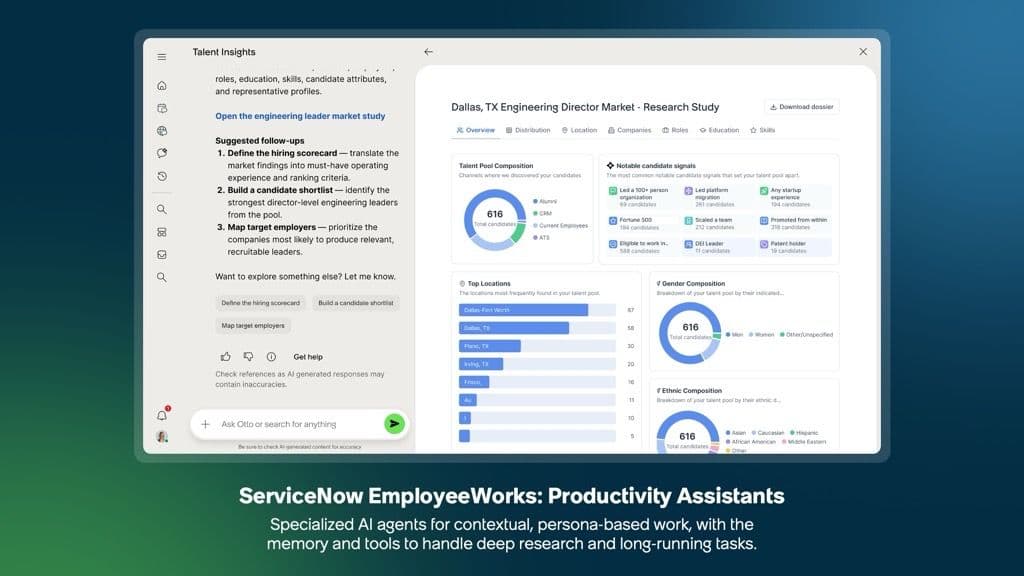
Productivity Assistants are designed for contextual, complex, and role-specific work, including research, long-running tasks, and activities involving multiple enterprise systems or AI agents.
Employees can configure assistants without coding, customizing their behavior, content, tools, and access permissions within guardrails defined by administrators. The system also supports persistent memory, allowing assistants to retain context while handling tasks that extend beyond a single interaction.
ServiceNow is introducing specialized assistants through its HR Service Delivery product, including a Talent Insights Assistant that provides candidate-fit and workforce insights through integrations with Findem and Phenom.
An HR Business Partner Assistant handles approvals, case management, and employee programs through conversational interactions, while a Manager Assistant provides coaching information, team-performance insights, and access to HR capabilities.
EmployeeWorks also includes two foundational assistants. The Research Assistant investigates questions across internal and external information sources and produces personalized responses in documents, presentations, or other formats based on a user's role and access.
The Calendaring Assistant connects with calendar systems to manage scheduling conflicts, reserve rooms, and add conferencing links. It can also handle more complex requests, such as arranging recurring individual meetings across a team while minimizing disruption to existing work.
"AI's real promise is to close the gap between intention and action,” said Jacqui Canney, chief people and AI enablement officer, ServiceNow. “This era demands that business leaders redesign work around their customers’ needs. When your technology supports that goal, your employees spend less time on coordination and more time solving customer problems that require human judgement. ServiceNow EmployeeWorks makes that shift possible."
Automating Repetitive Work With Productivity Routines
Alongside the assistants, ServiceNow is introducing Productivity Routines, which allow employees to create AI agents that execute predictable and repeatable tasks proactively.
Unlike assistants that respond to individual requests, these routines are designed to run in the background and complete predefined workflows without requiring employees to repeat the same instructions.
For example, a sales manager could configure an agent to review upcoming customer meetings, research relevant accounts using internal and external sources, and prepare tailored sales materials before the workday begins.
Employees create routines by describing the task they want to automate and selecting the necessary tools, without needing to understand backend systems, API integrations, or data models.
The approach gives employees more direct control over routine automation while keeping execution subject to enterprise governance.
ToolSmith Uses Natural Language to Build AI Integrations
ServiceNow is also introducing ToolSmith, an agentic development environment that allows developers to create automation tools for EmployeeWorks using natural-language instructions.
According to ServiceNow, ToolSmith is trained on more than 75,000 APIs and can manage the tool-building process from planning through implementation and testing.
Developers describe the required functionality, and the system generates an implementation plan, creates integrations, and builds tools intended to support reliable AI agent execution while improving token efficiency.
ToolSmith also includes debugging capabilities. When an integration fails, the system can retrieve relevant logs, identify potential issues, and suggest fixes. Developers can then test and refine the resulting tools through the same conversational interface.
The environment can also analyze logs to identify opportunities to improve existing workflows or develop new automations. ServiceNow says the approach can reduce some tool-development processes from days or weeks to minutes, although it has not provided independent performance benchmarks.
Bringing AI Agents Into Existing Workplace Applications
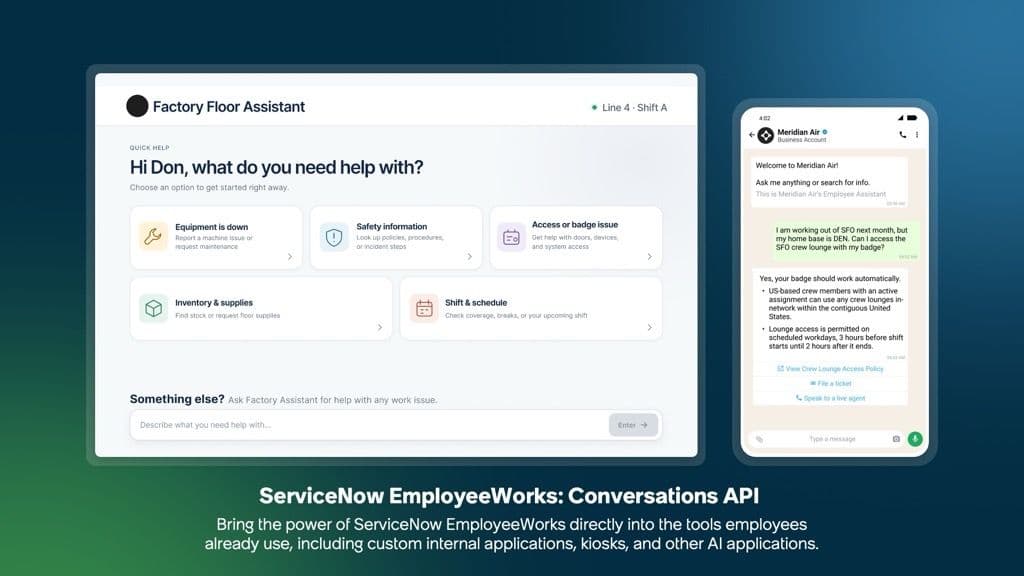
The update also introduces a Conversations API, allowing organizations to integrate EmployeeWorks capabilities into applications employees already use.
Through the API, businesses can make Productivity Assistants, Productivity Routines, and ToolSmith accessible from custom internal applications, kiosks, and other AI-enabled interfaces.
This could allow organizations to introduce automated workflows without requiring employees to move between separate platforms for each task.
The new Productivity Assistants, Productivity Routines, employee-centric AI harness, ToolSmith, and Conversations API are currently in controlled availability rather than general release.
ServiceNow has not specified a broader availability timetable or separate pricing for these capabilities.
The expansion reflects a wider shift toward AI systems that can execute business processes rather than simply provide information. For enterprises, the value of these technologies will depend on how reliably AI agents interact with existing applications, follow organizational policies, and complete tasks without introducing additional operational complexity.