Big Tech
Snowflake’s $300 Million Saudi Plan Targets Cloud and AI Skills


Two planned cloud regions and an MCIT-backed training program place local deployment and workforce capacity alongside the investment commitment.
[For more news, click here]
Saudi Arabia's digital expansion hinges on local cloud structure, and a workforce equipped to use it. For businesses developing AI applications, locally hosted data and practical technical skills are essential. Snowflake has set out a projected $300 million investment in Saudi Arabia through 2030, linking additional cloud capacity with local hiring, partnerships and data and AI training. They are planning for an expansion of their Saudi operations, including a collaboration with the Ministry of Communications and Information Technology (MCIT).
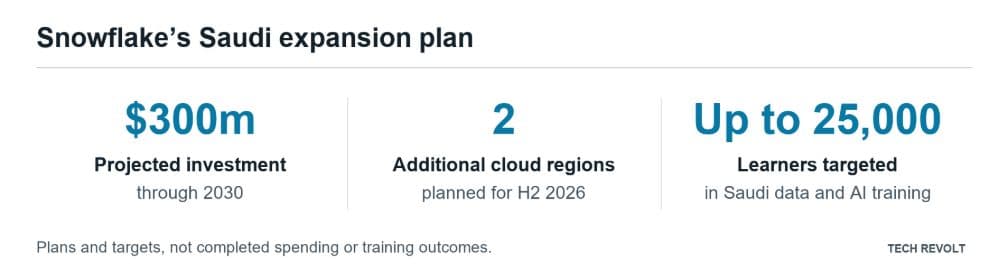
Graphic: Tech Revolt, based on the MCIT announcement and October coverage. Figures describe plans and targets.
MCIT outlined the package at LEAP 2026, while Argaam and Sharikat Mubasher reported on September 3 that the investment would support a regional headquarters, two additional cloud regions and training for 25,000 people.
For Saudi enterprises, the proposal addresses two connected requirements: access to cloud environments within the country and people equipped to use them. Snowflake is tying its infrastructure expansion to the skills and local relationships needed to support customer deployments.
More local cloud capacity
Snowflake plans to add two Saudi cloud regions in the second half of 2026, alongside its existing Google Cloud deployment in Dammam. Its supported-region documentation lists Dammam as Middle East Central2, with the identifier me-central2. The exact launch dates are to be released soon.
This builds on an existing Saudi presence. Snowflake’s December 2024 announcement confirmed both its Riyadh regional headquarters and general availability on Google Cloud in the Kingdom. The October update describes a formal inauguration of the Middle East, Turkey and Africa headquarters, alongside plans to expand the local team and partner network.
Region choice determines where an account’s data is stored and its computing resources are provisioned. Additional Saudi options would give customers more choice when selecting an environment for local workloads and deciding how to keep data within national borders.
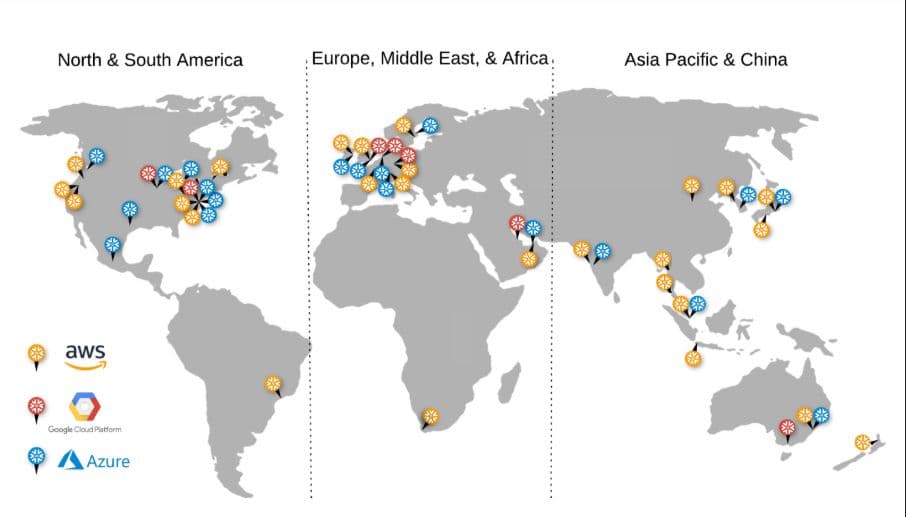
Snowflake’s existing cloud-region footprint. Image: Snowflake documentation.
In the statement carried by CXO DX, Michel Nader, Snowflake’s regional vice president for the Middle East, Turkey and Africa, said:
“Our projected $300 million investment reflects Snowflake’s confidence in Saudi Arabia and its digital future.”
Training alongside expansion
Snowflake and MCIT plan to provide data and AI upskilling for up to 25,000 learners through One Million Minds. The proposed delivery combines virtual and in-person training on Snowflake’s platform, certificates and practical projects through Snowflake University. The company also describes networking and mentoring opportunities through the Saudi Arabia Data and AI Community.
The initiative is intended to bring Snowflake Academia to the Middle East, helping universities incorporate current data and AI technology into their curricula. Linking education with the local operation could broaden the pool of people able to work with the platform, while giving Snowflake a larger community of potential users and practitioners.
One Million Minds is an existing global program. Snowflake launched it in January 2025 with a $20 million global investment and a goal of upskilling one million people by 2029. Saudi Arabia was among its named markets. The later 25,000-learner target concerns the Saudi collaboration, not the program’s worldwide reach.
The Saudi plan therefore combines a wider deployment footprint with the workforce and local relationships needed to support its use. Its commercial significance will depend on delivery: the $300 million remains projected investment, and the training figure is a target rather than a count of people already trained.