Fintech
Dubai Future Finance Week Day 2 Links Technology and Capital

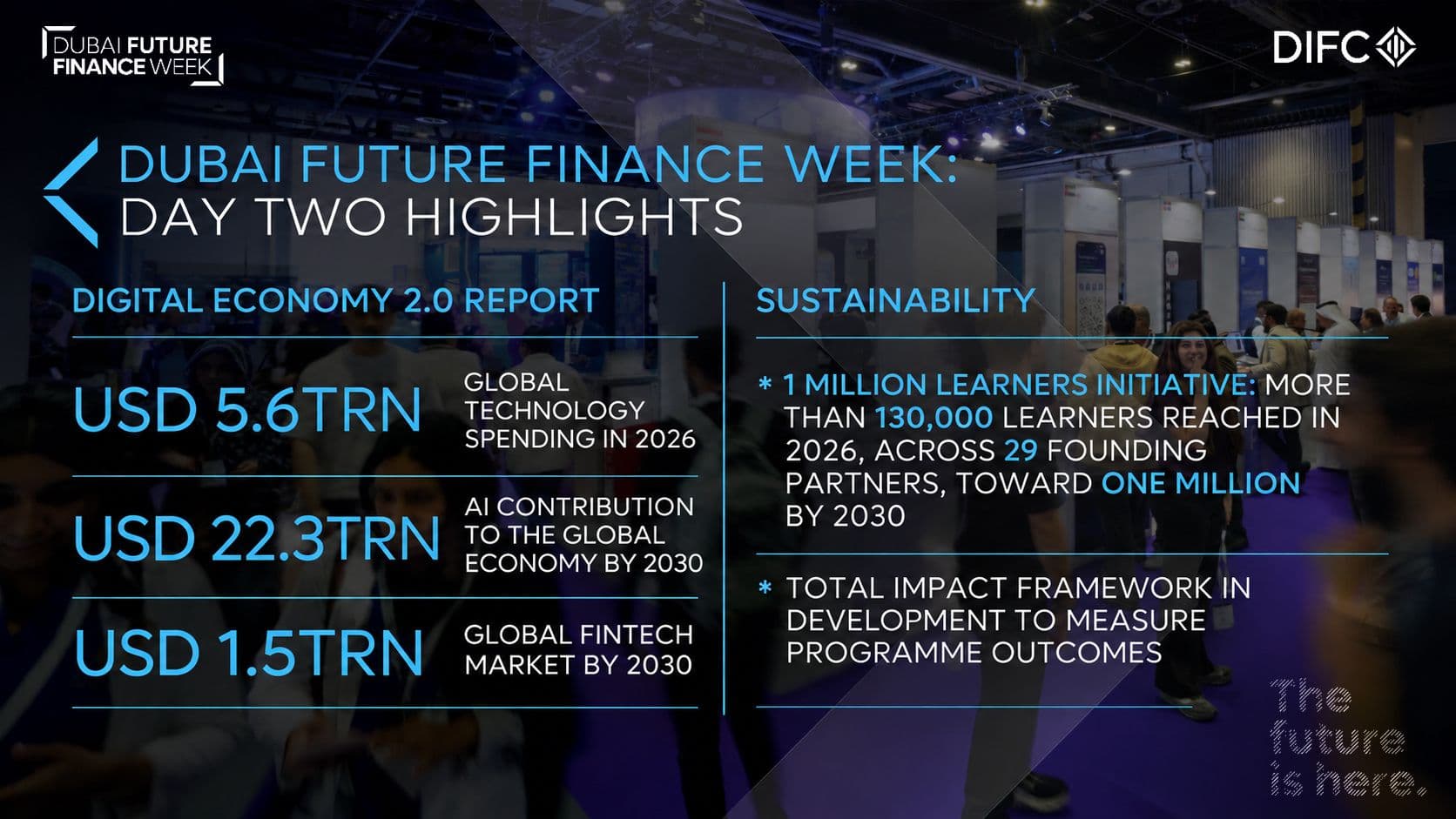
DIFC covered FinTech growth, sustainability skills and space-data pilots, alongside discussions on private capital.
For more news, click here
Capital, talent and regulation are central to turning financial technology into businesses that can scale. Those themes ran through the second day of Dubai Future Finance Week on November 3, as Dubai International Financial Centre (DIFC) outlined developments spanning its innovation community, sustainable finance and commercial uses of space-derived data.
At the Dubai FinTech Summit, Arif Amiri, chief executive officer of DIFC Authority, announced that the center now hosts more than 2,000 AI, FinTech and innovation companies. The milestone comes less than ten years after DIFC launched its future-of-finance vision.
Supporting the next stage of financial technology
The company count provides one indication of the business community available to investors, financial institutions and technology partners. Amiri linked that growth to DIFC's ambition to help companies expand internationally.
Arif Amiri said:
“Our ambition is not simply to attract promising businesses, but to give them the environment, connections and capabilities they need to scale globally.”
DIFC and its research partner Asia House also launched the Digital Economy 2.0 report. It projects a global FinTech market worth $1.5 trillion by 2030 and identifies capital, talent and progressive regulation as important conditions for digital economic growth. The forecast frames the opportunity ahead, and explains what businesses need to pursue it.
The summit's signature session featured Noel Quinn, chairman of Julius Baer, bringing an established financial institution into the day's discussion.
Connecting sustainability skills with measurable outcomes
The Future Sustainability Forum examined transition finance, climate adaptation capital and sustainable investment strategies aligned with the UAE's Net Zero 2050 goals. The agenda connected the need to finance economic change with the skills required to assess and manage those investments.
DIFC's 29 founding partners in the 1 Million Learners initiative have collectively reached more than 130,000 learners in 2026. The initiative aims to equip one million people with sustainability and sustainable-finance knowledge by 2030.
DIFC is developing a Total Impact Framework to assess the program's economic, social, environmental and governance contribution. It will establish indicators for partners to report impact data consistently, providing a basis for evaluating achievements.
Alya Al Zarouni, chief operating officer of DIFC Authority, said:
“Sustainability is increasingly integral to the future competitiveness and success of financial services.”
Linking private capital with practical applications
IPEM Future Dubai brought together private equity, private credit and institutional investors to discuss long-term capital formation. The Capital Exchange GP-LP Programme focused on allocation priorities, fund strategies and co-investment between fund managers and the investors supplying their capital. These discussions addressed the investment relationships that businesses need as they grow.
The wider program included InsureTek Middle East, while the MENA Banking Excellence Awards were scheduled for the evening.
DIFC Innovation Hub also highlighted progress on Space for Earth Labs, established with the Mohammed Bin Rashid Space Centre to apply space-derived data and AI to commercial and public-sector challenges. Its Geospatial Accelerator, delivered with program partner RELM Insurance, attracted 73 applications from 24 countries and matched international scale-ups with five UAE organizations.
The resulting proof-of-concept pilots cover maritime safety, insurance, the built environment and public safety. They were presented at the Dubai AI Festival in October, showcasing the ongoing work. Their commercial relevance lies in testing how space-derived information could support decisions in those sectors. Wider deployment would depend on what those pilots establish.
We see the growth of DIFC's technology community with investment relationships, workforce capabilities and practical experimentation. For financial institutions and businesses, the value will depend on those connections producing usable services, effective investment and demonstrable outcomes.