Technology
Microsoft outage reveals the hidden risks of enterprise cloud and AI dependence

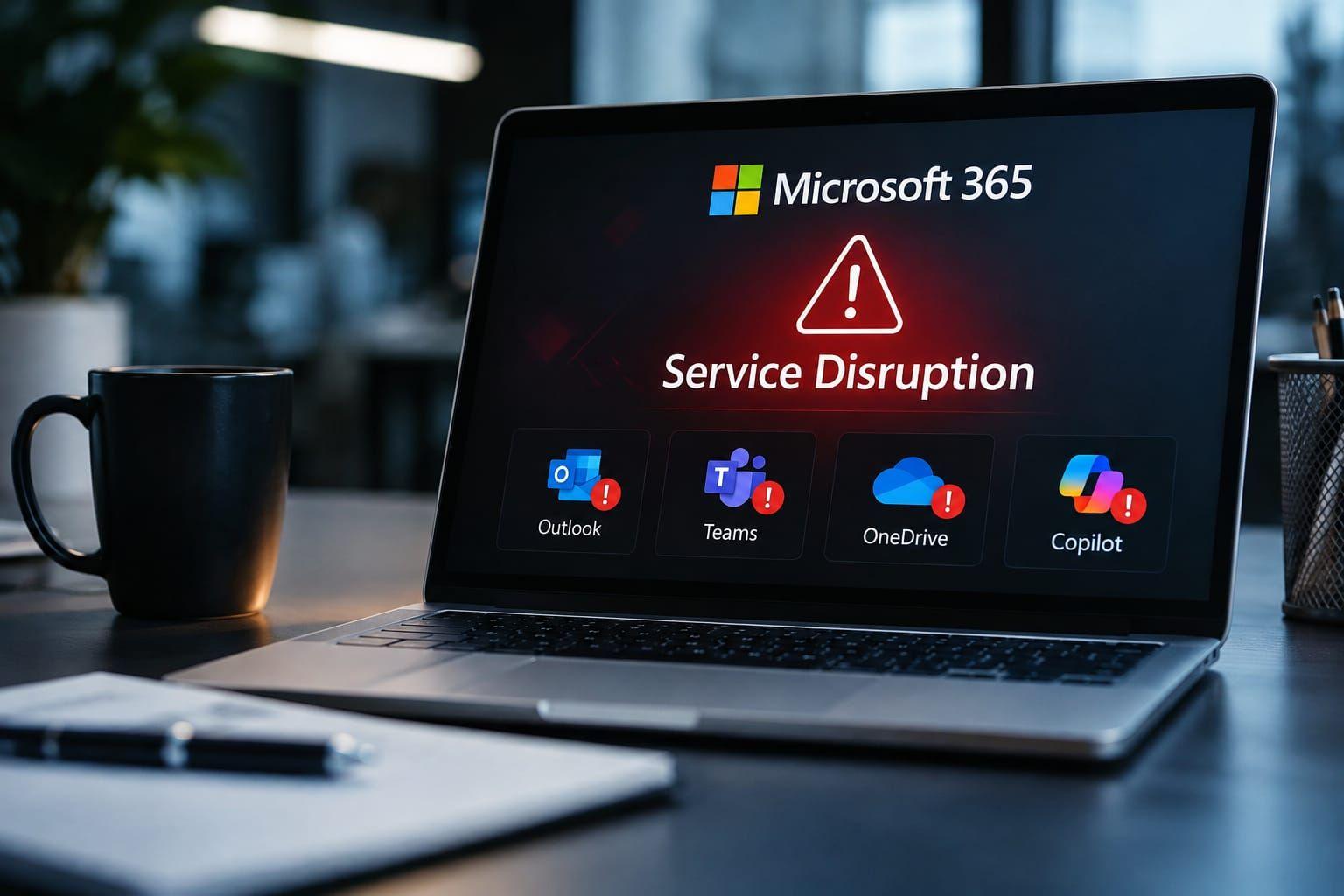
Microsoft's widespread service disruption raises questions about how heavily businesses depend on cloud platforms and whether their continuity plans are prepared for failures affecting connected services and AI tools.
[For more news, click here]
Cloud platforms have transformed how businesses operate, making communication, collaboration and data management easier but they have also made everyone dependent on various platforms and technology providers. When one of these platforms experiences an outage, the disruption goes beyond individual applications and affects entire business workflows.
The Microsoft 365 outage on November 12 offered a clear example of that dependence. Problems affecting Outlook, Teams, Copilot and other services disrupted businesses and government organizations across several countries, with the effects continuing into November 13. Down detector recorded more than 130,000 reports of Outlook problems in the United States at the peak, although those reports do not represent a verified count of affected users.
Microsoft said unexpectedly unavailable servers placed additional pressure on its remaining infrastructure, while recovery efforts produced inconsistent results. The company reported no evidence of a cyberattack, and a definitive root cause had not been established in its initial updates.
Yet the significance of the incident extends beyond the technical problem itself. It highlights how much of modern business now depends on systems that organizations do not directly control.
The hidden cost of cloud dependence
The shift to cloud computing has allowed businesses to reduce infrastructure costs, simplify IT management and access sophisticated tools without maintaining every system internally. For many organizations, services such as Microsoft 365 are no longer optional productivity tools; they have become essential infrastructure supporting daily operations.
The challenge is that businesses rarely depend on these services individually. Email, calendars, file storage, collaboration tools and security systems are often connected through shared identities, APIs and administrative platforms. A disruption affecting one component can therefore interfere with several business activities, even when the other applications remain technically operational.
Consider a company that relies on Outlook for customer communication, Teams for internal coordination and Microsoft 365 for document management. If employees cannot access their email or meeting schedules, the consequences may extend to customer support, internal approvals and time-sensitive transactions. Businesses may have backup systems for their servers and databases but lack practical alternatives for the communication services their employees use every day.
This concentration of risk does not mean that cloud services are inherently less reliable than on-premises infrastructure. Cloud providers invest heavily in redundancy, security and recovery capabilities that many individual organizations could not afford. The problem emerges when businesses assume that the provider's resilience automatically guarantees the continuity of their own operations.
AI is creating another layer of dependency
The growing integration of artificial intelligence into enterprise software makes this issue more complicated. AI assistants and agents are increasingly designed to retrieve emails, summarize documents, schedule meetings and perform tasks across business applications. Their usefulness depends not only on the models themselves but also on the systems providing access to business information.
That dependence became visible during Microsoft's disruption. OpenAI reported problems with its Microsoft 365 connectors, while Anthropic confirmed that the incident affected access to mail, calendars and other connected functions. This did not mean the companies' underlying AI models had stopped working. Instead, specific capabilities became unavailable because they relied on an external service experiencing problems.
For enterprises adopting AI agents, this distinction matters. A system may be technically operational but unable to complete a task if it cannot retrieve the necessary information or communicate with another application. As businesses give AI tools more responsibility, these dependencies could become increasingly important to operational planning.
Organizations therefore need to evaluate AI reliability at the workflow level, not simply through model performance or platform availability. An AI assistant that works accurately under normal conditions may still be ineffective when an essential connection fails. Businesses should understand which external services their AI tools depend on, what happens when those services become unavailable and whether critical tasks can continue through alternative processes.
Business continuity needs to go beyond IT recovery
The Microsoft outage raises an important question for business leaders: how long could their organization continue operating without its main cloud productivity platform?
Traditional disaster recovery planning often focuses on restoring servers, applications and data. However, modern business continuity also requires identifying the external services supporting critical activities and determining what employees can do when those services are temporarily inaccessible.
This includes maintaining secure alternative communication channels, ensuring essential contact information remains accessible and establishing manual processes for high-priority operations. Simply subscribing to several cloud providers may not solve the problem if those services still depend on the same identity system, communication platform or external integration.
Microsoft's own enterprise continuity guidance recommends mapping critical business processes to their technology dependencies and preparing alternative communication methods before an incident. These arrangements also need regular testing because a backup plan that employees have never practiced may prove difficult to execute during an outage.
The financial implications make these preparations increasingly relevant. According to Uptime Institute's 2026 Annual Outage Analysis, 57% of respondents to its 2025 annual survey said their most recent major outage cost more than $100,000. The figure is not a measure of the Microsoft incident's losses, but it illustrates why service interruptions deserve attention beyond IT departments.
Resilience is becoming a leadership responsibility
The central lesson from Microsoft's outage is not that organizations should abandon cloud computing or avoid integrating AI into their operations. These technologies continue to offer substantial advantages. The more important question is whether businesses understand the risks created when their most essential activities depend on interconnected services.
That makes resilience a responsibility for senior leadership as much as for technology teams. Executives need to know which business functions cannot tolerate extended disruption, where their most significant technology dependencies exist and whether employees can continue essential work when those systems are unavailable.
As cloud platforms become more integrated and AI agents take on additional responsibilities, the ability to operate through temporary disruptions will become an important measure of organizational readiness. Businesses cannot prevent every outage affecting their technology providers, but they can determine how prepared they are when one occurs.
The disruption extended beyond Microsoft's own services
The impact of the Microsoft outage was not limited to Outlook, Teams and Copilot. GoDaddy confirmed that customers using its Microsoft 365 email service experienced problems accessing webmail and setting up accounts, showing how businesses can be affected by outages at technology providers they rely on indirectly.
The disruption also reached AI applications connected to Microsoft's services. OpenAI reported errors affecting its Microsoft 365 connectors, while Anthropic confirmed that users experienced failures when accessing emails, calendars and other Microsoft-connected functions through Claude.
The disruption coincided with a wider increase in reported problems across the internet. PCWorld reported that Down detector recorded spikes involving Amazon, Facebook, Salesforce, Slack and Reddit, among other services. However, these reports did not establish that the platforms were experiencing confirmed outages or that their problems were caused by Microsoft's infrastructure. At the time, Google Cloud and Cloudflare had not reported a comparable widespread disruption.
The distinction is important, but so is the broader lesson. Modern businesses depend on interconnected platforms, third-party applications and external services to complete everyday tasks.
Even when an application remains operational, it may lose essential functionality if a service it depends on becomes unavailable. For enterprises, understanding these connections is becoming a critical part of business continuity planning.