Deep Tech
IBM, AMD and Oak Ridge Team Up for Reliable Quantum Computing

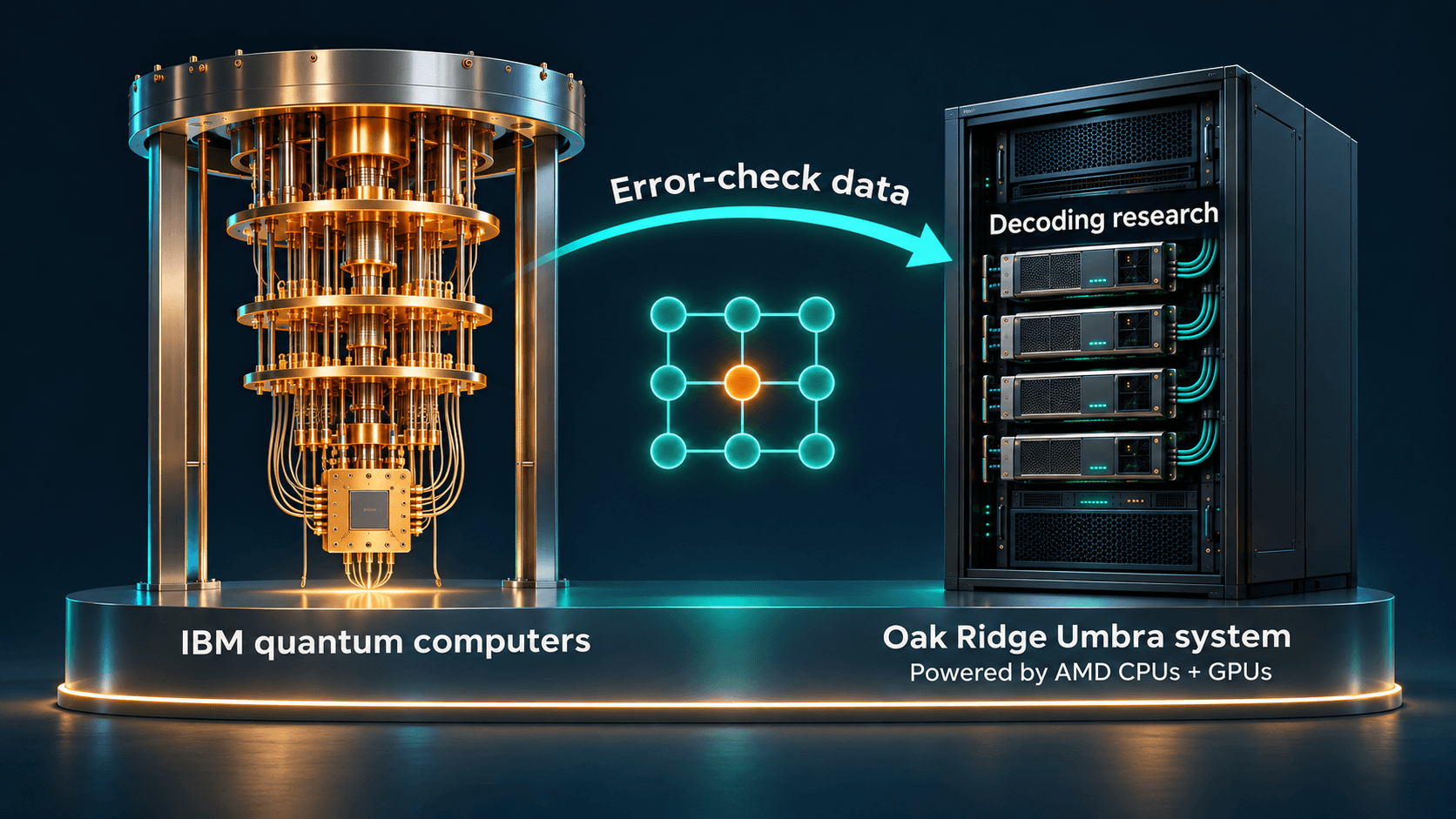
A shared research platform brings quantum processors and supercomputing together, supporting a push toward scientifically useful machines by 2028.
For more news, click here
Quantum computing could give scientists a better way to study molecules and materials that are difficult to model with conventional machines. Making those calculations dependable would help turn the technology into a practical tool for chemistry, energy research and industrial discovery.
IBM, Oak Ridge National Laboratory and AMD are building toward that goal through a new quantum error-correction platform, announced on November 5. It gives researchers a shared environment to develop the methods and computing systems that more reliable quantum machines will need.
The platform sits at IBM’s Poughkeepsie site in New York. It pairs IBM quantum computers, including the 120-qubit Nighthawk processor, with Oak Ridge’s Umbra high-performance computing system. AMD supplies the conventional computing foundation, including Instinct MI355X graphics processors and fifth-generation EPYC CPUs.
Helping Quantum Computers Work Reliably
Qubits, the basic units of quantum information, are sensitive to disturbances. Error correction protects that information by spreading it across multiple qubits and repeatedly checking for errors. Conventional computers interpret those checks using software called decoders. They must keep pace with the quantum processor, which is another challenge.
Placing the systems together reduces communication delays and supports faster feedback during calculations. Researchers can compare correction methods, test how much computing power they require and explore where GPUs make the greatest difference.
The shared infrastructure also lets teams focus on algorithms and experiments without assembling their own connections between separate computing systems. That could make it easier to develop approaches that work across the hardware, software and controls of a future quantum computer.
Jay Gambetta, director of IBM Research, described the research priority in the announcement:
“Today, the question is how to accelerate and optimize error correction to build systems that scientists can use to tackle meaningful problems.”
A Path Toward Scientific Applications
The effort aligns with the US Department of Energy’s Quantum Genesis Mission and its goal of scientifically relevant quantum computing by 2028. The department’s Q Competition, announced in September, carries up to $215 million in planned funding. It seeks systems with at least 100 logical qubits, which store quantum information with protection against errors.
DOE identifies chemistry, materials, physics and applied mathematics as target fields. Its funding approach rewards technical milestones and working scientific demonstrations, directing investment toward machines that can tackle demanding research problems.
For IBM, lessons from the platform will help inform Quantum Starling, its fault-tolerant system planned for 2029. The company is targeting 200 logical qubits and 100 million quantum operations. The ambition is to sustain much longer calculations while controlling the errors that would otherwise undermine their results.
Existing work offers a view of the applications these systems could support. In July, Oak Ridge and its collaborators reported calculations involving a molten salt being studied for fusion reactors. The research examined molecular configurations relevant to producing and extracting tritium, a fuel needed by many proposed fusion systems.
Earlier in 2026, IBM and collaborators also simulated a magnetic material and compared the results with neutron-scattering measurements. Such work shows why researchers want dependable quantum calculations: they could help explain how materials behave and guide the search for useful properties.
For industries developing energy technologies, the potential value is a stronger basis for choosing which materials to test. More accurate simulations could help researchers narrow promising options before committing to expensive experiments.
The platform’s immediate contribution is a place to test and refine the methods behind that progress. The 2028 scientific-computing goal and IBM’s 2029 Starling target provide the longer development horizon. As the systems improve, the promise is more dependable research tools that help turn difficult scientific questions into useful discoveries.