Technology
No Hack Required: How Small Tech Failures Become Global Disruptions.


A week of outages across aviation, banking and cloud services exposed the gap between society's dependence on technology and its ability to keep operating when routine faults occur.
[For more news, click here.]
Commercial software and communications networks help determine whether payments clear, flights depart and public institutions can complete their work. The outages of November 12 to 17 exposed how quickly problems inside those systems can become disruptions far beyond them.
Across aviation, banking, consumer services and classified communications, the failures had different reported triggers. Together, they raise a common question about operational resilience: how much essential activity can continue when the technology supporting it becomes unreliable?
Updates, transactions and the second cascade
On November 17, Apple attributed outages affecting services including iCloud and Apple Pay to an internal update and ruled out a cyberattack. The National Security Agency (NSA) separately confirmed degradation during scheduled maintenance, while saying mission-critical capabilities remained operational. Neither disclosure provided a full technical explanation. Reuters on Apple
On November 16, JPMorgan Chase attributed transaction delays to a software bug in its on-premises hardware systems. Other banks could experience delays when they were parties to transactions with Chase. U.S. Bank said its own systems were not directly affected, although customers could encounter delays in Zelle payments involving another institution. Reuters reporting
That is another form of dependence: a bank can remain operational while its customers encounter problems because completing their transaction requires another institution's systems to work.
The succession also generated anxiety about whether something larger was happening. In coverage of the outages, Vanity Fair described readers asking what was going on and considered whether a hostile state might be involved. Such questions illustrate how uncertainty becomes part of the story, even when an attack has not been established. Vanity Fair coverage
Officials reported no evidence that the incidents formed a coordinated attack. Still, a delayed transfer can become a concern about an account's security, and several outage headlines can suggest a common threat. Technical disruption creates the conditions for a second cascade through public confidence. AP reporting on the official assessment
A local fault, a national stop
On November 13, the Federal Aviation Administration experienced network instability that reached 17 of its 22 regional air traffic control centers. Its preliminary investigation identified two potential sources of excessive data, in Texas and Arkansas, including an El Dorado communications site where work included installing a new router.
The agency reported roughly 1,000 connection attempts every four to five seconds. A technical problem around 3:30 p.m. ET prompted a nationwide ground stop, with air traffic resuming at 8:15 p.m. It reported approximately 12,462 flight cancellations that day. FAA account
Safety procedures preserved reliable communications and radar capabilities for aircraft to land, and critical flights continued. Nevertheless, disruption associated with routine equipment work had consequences across national aviation. The protective stop worked; the underlying infrastructure could not sustain normal service.
Software defects and equipment faults are foreseeable operating conditions. The resilience question is why their effects travel so far, and whether isolation, alternatives and recovery arrangements are adequate for the activities depending on them.
When email becomes public infrastructure
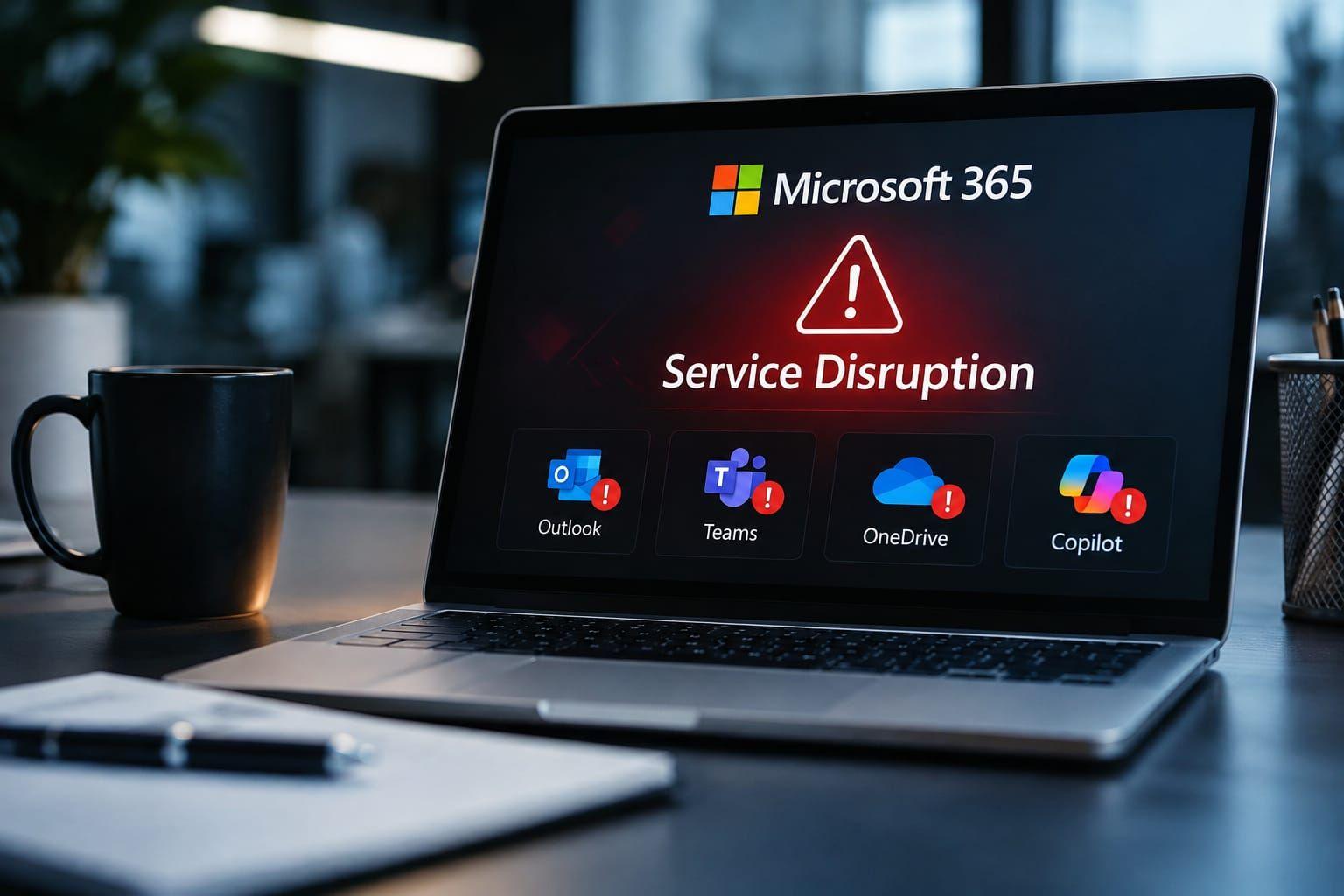
Microsoft's preliminary report offers a detailed account of propagation. A defect introduced in July remained dormant until changed traffic patterns and reduced capacity exposed it. Teams traffic had shifted onto gateways also supporting Exchange Online, while nearly 14% of gateway server capacity was already unavailable because of an unrelated issue.
Automatic redirection then moved requests from failing servers onto surviving ones, which encountered the same problem. Regional barriers failed to contain the cascade. More than 80% of the affected gateway servers became unresponsive at the worst point, and restarted machines were overwhelmed again by waiting traffic. The incident lasted 23 hours and 50 minutes, with Exchange Online mailbox access through Outlook particularly affected. Microsoft preliminary report
The consequences reached national judicial administration. Brazil's National Justice Council suspended the counting of procedural deadlines nationwide for November 12 and 13 because Microsoft 365 instability compromised judicial communication and work tools. The order provided for deadlines to resume on November 16. Council order
A commercial service failure had required a nationwide procedural response. Outlook, Microsoft's email application, was an access point to infrastructure on which public institutions depended. The order exposes how far that dependence reaches, even into the administration of justice.
Cape Town also issued an official notice identifying disruptions to Outlook, Teams and file access, locating the problem in Microsoft's global infrastructure. These geographically separate institutions shared exposure to a provider's failure, despite having different responsibilities and local technology environments. City notice
Resilience has to match dependence
The mechanisms are familiar. Google's reliability guidance describes how lost capacity overloads remaining systems, and how recovery actions can spread failure. Resilience requires capacity, isolation, controlled traffic and tested recovery. Extra servers alone may offer little protection if the same conditions disable all of them. Independence matters as much as the number or location of backups.
Those protections require sustained resources. Security technologist Bruce Schneier, speaking to Tom's Guide about redundancy and the Chase outage, argued:
"Fragile systems are the most profitable in the near term. And there is no incentive to focus on the long term."
His criticism concerns incentives to fund resilience, rather than a documented budget explanation for every incident. Tom's Guide interview
There is historical precedent for looking beyond the immediate fault. An NSA assessment of its January 2000 network outage found no evidence of malicious activity and identified deeper problems involving resources, management and implementation of a complex network. That report cannot explain the current disruption, but it shows that the organizational roots of infrastructure failure have long been recognized. Declassified assessment
The Financial Stability Board similarly treats systemic third-party dependencies as a resilience concern. Financial institutions can gain efficiency from shared providers while inheriting risks that extend beyond their direct control. FSB toolkit
Operational resilience is a measure of institutional competence. Foreseeable faults demand credible containment, funded and tested before a disruption. These incidents put investment, testing and alternatives under scrutiny, even as their differing disclosures leave specific responsibility unresolved.
Society's dependence is already visible in grounded departures, delayed payments and suspended court deadlines. The standard for infrastructure must therefore include how much essential work survives a failure. Ordinary glitches become major disruptions when the systems built around them have too little room to fail safely.