Fintech
Singapore FinTech Festival 2026 Opens With AI, Digital Payments and a Push to Rewire Global Finance

Day 1 brought new plans for AI in financial services, changes to Singapore’s national payments infrastructure and commercial initiatives aimed at bringing agent-led transactions closer to everyday use.
[For more news, click here]
Artificial intelligence is beginning to take on a more direct role in financial services, moving from tools that assist employees to systems that could influence lending decisions, detect suspicious transactions and initiate payments. How banks manage that shift, particularly when financial activity crosses institutional boundaries, is becoming an important question for regulators. At the opening of the 11th Singapore FinTech Festival on November 18, Deputy Prime Minister and Monetary Authority of Singapore (MAS) Chairman Gan Kim Yong set out three National AI Missions intended to address some of these challenges.
Singapore sets out three AI missions for financial services
Gan’s three National AI Missions focus on strengthening financial crime prevention, improving access to financing for small and medium-sized enterprises (SMEs), and enabling AI agents to carry out financial transactions safely.
The first mission addresses the difficulty banks face in identifying scams that move across institutions. A victim’s money can pass through several banks within minutes, leaving individual institutions with only part of the transaction trail. Five banks are already participating in a proof-of-value exercise in which transaction data is pooled securely, so AI models can identify suspicious patterns across institutions. The findings will inform an industry-wide Scam Detection Utility, with MAS planning to begin a design study in early 2027. Initial work will focus on accounts and data in Singapore, although the authority sees potential for cooperation with other jurisdictions over time.
The second mission looks at how AI and wider data sources could improve SME credit assessments. Traditional lending decisions often rely on past financial performance, repayment histories, collateral and personal guarantees. These measures may not fully capture the creditworthiness or potential of newer businesses with limited track records or assets. MAS plans to invite AI technology companies to develop and test solutions using realistic synthetic data, with financial institutions and public agencies contributing data and expertise. Feedback from SMEs will also help assess whether the proposed solutions address their financing needs.
The third mission concerns AI agents that can make payments and manage financial transactions on behalf of people and businesses. MAS plans to work with the industry on purpose-bound money, which can be programmed with conditions governing when and how funds are released. A payment, for example, could be executed once specified contractual terms have been met and checked.
“Institutions and enterprises remain accountable for actions taken on their behalf, with safeguards built in from the start,” Gan said.
The Future of Finance Institute (FFI) will coordinate work across the missions, bringing together financial institutions, researchers, technology companies and public agencies. Its initiatives include an Agentic Money Sandbox for testing agent-led transactions in controlled environments, alongside work to develop shared guidance, standards and resources for AI risk management. The institute will also support the development of AI capabilities and talent across the financial sector.
PayNow roadmap expands beyond everyday transfers
MAS and the Association of Banks in Singapore (ABS) released the Phase 2 roadmap for PayNow Generation 2, with enhancements scheduled for progressive implementation across 2027 and 2028.
The proposals include greater QR payment interoperability through SGQR+, allowing customers to use their preferred payment applications at participating merchants without having to check which QR schemes they accept. The initiative is also intended to make it easier for visitors to pay in Singapore and for Singapore residents to use local payment applications when traveling in connected markets. Work on the SGQR+ switch has begun, with a limited rollout planned for 2027 and a wider expansion in 2028.
Online payments are also set for changes through deep-linking. Customers will be able to move from an e-commerce checkout directly into their preferred payment application, rather than saving a QR code and retrieving it from their phone’s gallery. MAS and ABS plan to develop common technical standards and a central facility by the end of 2027, supporting broader adoption through 2028.
The roadmap also addresses high-value and high-volume payments, clearer rules for merchant disputes and refunds, and richer payment data to help businesses automate processing and reconciliation. MAS and ABS will work with industry participants to validate ways of processing very small, high-frequency payments economically, including transactions that could be initiated by AI agents. Their work on smarter business payments will also examine tokenized payment credentials for recurring and contactless transactions.
MAS plans to develop a Future Payment Rails Blueprint in 2027, setting out how Singapore’s payment infrastructure could support a more connected and automated economy.
Visa moves agentic commerce toward live transactions
Visa announced several initiatives at the festival, including an expansion of its Agentic Ready program across Asia Pacific. The second phase focuses on payment acceptance, bringing more than 50 acquirers, payment service providers, payment gateways and selected merchants into preparations for agent-initiated Visa transactions. The program builds on its first phase, which has attracted more than 100 issuers across 10 markets in the region.
“Agentic commerce will only scale if merchants and their payment providers can support AI transactions securely and reliably, while maintaining control over the customer experience.” said T.R. Ramachandran, Visa’s Head of Products and Solutions for Asia Pacific
A separate collaboration with Lianlian DigiTech demonstrated how those transactions could work in practice. The companies completed a live business-to-business transaction in Asia Pacific using a tokenized payment credential designed specifically for an authorized AI agent. Lianlian’s XWorker agent obtained its own credential through Visa Intelligent Commerce Connect and completed an office supply purchase. The companies also introduced LianLian XCard, which is designed to help businesses manage AI-assisted spending through card limits and transaction thresholds.
Visa also announced plans to extend stablecoin-powered prefunding for cross-border payouts through Visa Direct into Asia Pacific. Eligible clients will be able to use supported stablecoins to fund payouts, while recipients continue to receive funds in traditional currency. The capability is intended to give businesses greater flexibility in managing liquidity and funding international transfers.
Separately, Visa and Ant International’s Alipay+ announced a Scan to Pay rollout connecting Visa credentials held in participating digital wallets with Alipay+’s QR merchant network across Asia Pacific outside mainland China. The initial arrangements include eligible Samsung Wallet users in Singapore and Australia paying at participating Alipay+ merchants in Hong Kong and Malaysia, as well as supported Google Wallet users traveling to Singapore.
Visa also launched its Threat Intelligence Platform in Asia Pacific, bringing together cyber and payment intelligence to help financial institutions identify threats that could lead to fraud and financial losses. Research commissioned by Visa found that 60% of surveyed financial institution leaders in the region reported an increase in fraud sophistication over the previous 12 months, while 57% reported an increase in fraud velocity. The institutions surveyed reported average payment-related fraud losses equivalent to US$12.8 million during the same period.
OCBC joins quantum banking testbed
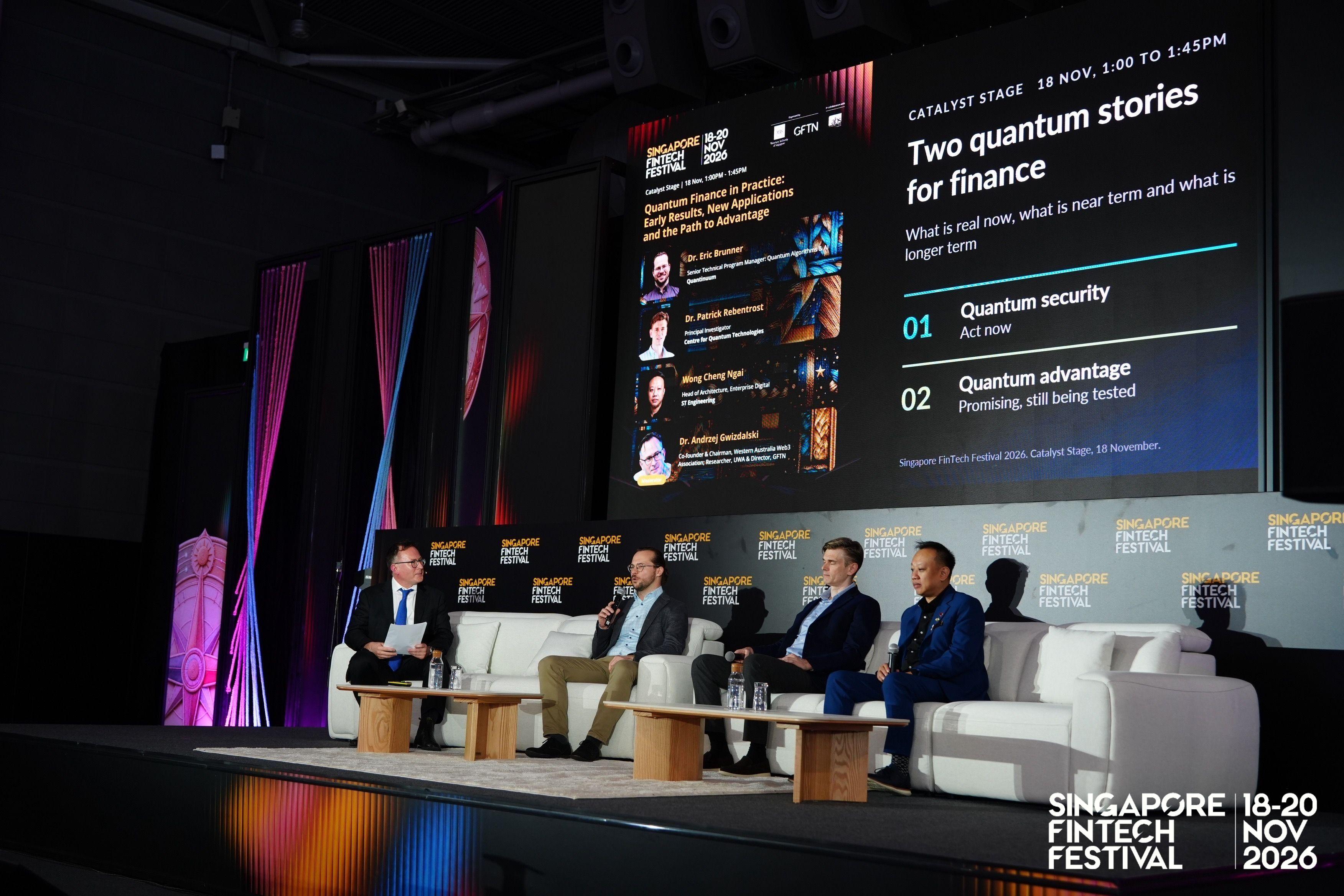
Quantum computing featured in a Q-FINEX session examining its potential applications and risks for financial services. The program also included the launch of a global quantum finance challenge, which will conclude at Black Swan Summit Perth 2027, and the Q-FINEX Quantum Finance Report.
A more concrete development came from OCBC, which joined a Q-FINEX testbed led by the Global Finance & Technology Network (GFTN), with ST Engineering as implementation partner and researchers from the University of Western Australia’s Quantum Information, Simulation and Algorithms center. The collaboration will examine banking applications involving credit and counterparty risk, as well as optimization.
ST Engineering will use its Quantizant platform to assess OCBC’s quantum readiness and develop a roadmap for transitioning to post-quantum cryptography. Researchers will also examine the bank’s use cases through quantum and hybrid algorithms, comparing their performance with conventional methods. The work addresses both the potential of quantum computing to handle complex financial calculations and the longer-term risk it could pose to existing encryption methods.
Semiconductor controls add an infrastructure concern
Gan also addressed new US Department of Commerce rules on remote access to advanced semiconductors. Under the requirements, companies will need licenses to export or re-export advanced chips to five countries, including Singapore. The government is assessing the implications for affected businesses and engaging with US authorities to facilitate access for companies operating in Singapore. Gan said the country would not allow businesses to use their association with Singapore to circumvent or violate other jurisdictions’ laws.
The issue adds an infrastructure consideration to the financial sector’s AI plans, as access to advanced computing hardware remains important to the development and operation of increasingly sophisticated AI systems.
Related Articles
Saudi Arabia Is Building the Infrastructure Behind Its AI Ambitions at LEAP 2026
LEAP 2026 Ends With Saudi Arabia Turning to the People Behind Its AI Push
At LEAP 2026, Saudi Arabia’s AI Spending Meets the ROI Problem