AI
Google Adds Two New TPU Systems to Its AI Chip Portfolio

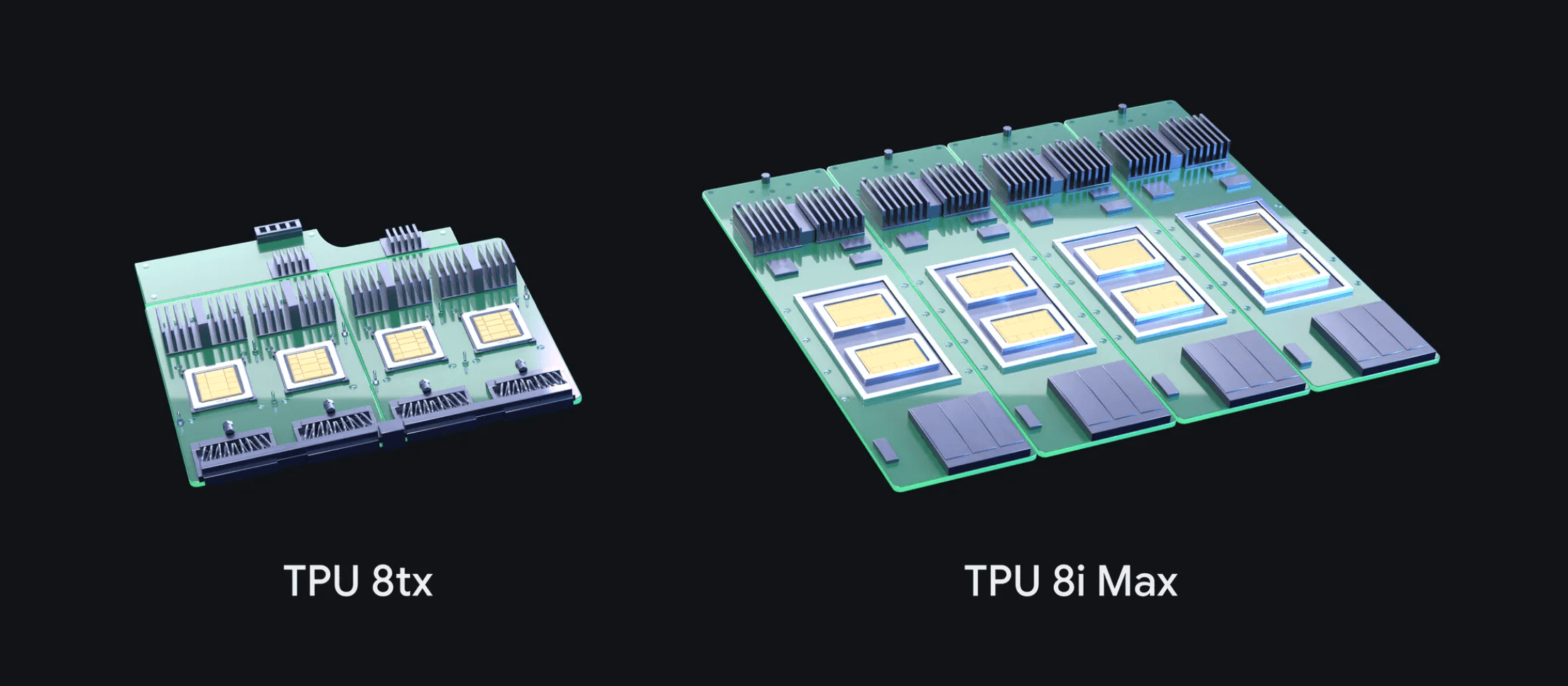
The TPU 8tx and TPU 8i Max target confidential computing and memory-intensive AI workloads as Google expands its custom chip business beyond its own infrastructure.
[For more news, click here]
Google has expanded its eighth-generation Tensor Processing Unit (TPU) portfolio with two new systems designed to address different demands emerging in enterprise AI. Announced on November 9, the TPU 8tx focuses on protecting sensitive information during processing, while the TPU 8i Max combines two processors to provide greater computing power and memory capacity for demanding AI applications.
Following the introduction of TPU 8t and TPU 8i at Google Cloud Next in April, the latest additions bring the eighth-generation lineup to four configurations covering large-scale model training, low-latency reasoning, confidential computing, and memory-intensive workloads. Rather than introducing entirely new chip architectures, Google has built the latest systems around its existing silicon, changing their packaging and supporting infrastructure to serve specific applications.
Inside Google's Two New AI Computing Systems
Designed for organizations handling confidential information, the TPU 8tx is aimed particularly at regulated industries such as finance and government. While encryption protects data during storage and transfer, information must generally be accessible to a processor during computation. Google's new configuration uses hardware-level confidential computing to protect sensitive data and model weights while they are being processed.
Based on the same underlying silicon as TPU 8t, the system is paired with fifth-generation EPYC host processors from AMD and Google's Boardfly networking architecture. According to Google, this combination delivers up to twice the speed, or half the latency, compared with TPU 8t, with virtually no performance penalty from its security features. Beyond confidential inference, the system supports model fine-tuning using private datasets, model distillation, and reinforcement learning for AI agents.
A different challenge is addressed by the TPU 8i Max, which targets applications such as coding assistants, mathematical reasoning, and video analysis. These workloads can require AI models to retain and access large amounts of information throughout extended tasks. Google has combined two TPU 8i chips into a single package, doubling computing power, on-chip static random-access memory (SRAM), and high-bandwidth memory (HBM) bandwidth compared with the standard TPU 8i.
The resulting configuration provides 768 MB of on-chip SRAM and 17.2 TB per second of HBM bandwidth. Google also says it fits twice the silicon within the existing rack footprint, potentially allowing data center operators to increase computing density without expanding their physical infrastructure at the same rate.
Google's Push into the Wider AI Infrastructure Market
Beyond the hardware itself, Google is looking to grow its custom chip business outside its own services and cloud infrastructure. Its TPUs have supported internal workloads, including the development and operation of Gemini, but the company is increasingly making the processors available to external customers.
Nearly 100 customers are now using Google's TPU infrastructure, according to the company. They include AI research laboratories, trading firms, retailers, and universities. Google is also working to make its processors easier for developers to adopt through open-source TorchTPU, which supports PyTorch and Hugging Face models, alongside integrations with inference frameworks such as vLLM and SGLang. These efforts are intended to reduce the development work involved in moving AI applications to its hardware.
Competition with NVIDIA remains a significant part of this expansion. NVIDIA's GPUs continue to dominate much of the AI computing market, supported by its established CUDA software ecosystem. Google's strategy is to give businesses another hardware option while making the transition less demanding for developers already working with established AI frameworks.
Oracle has announced plans to offer Google's eighth-generation TPUs through Oracle Cloud Infrastructure in 2027, potentially giving the company access to customers that do not currently use Google Cloud. It also extends Google's reach into a market where cloud providers are increasingly looking to offer alternatives to NVIDIA-based infrastructure.
However, the new systems will still need to prove their value in commercial deployments. Google has yet to disclose pricing or general availability dates for the TPU 8tx and TPU 8i Max, leaving businesses without a clear basis for comparing their costs with existing alternatives. Their adoption will ultimately depend on how well they perform in real workloads and whether companies can integrate them into their existing AI infrastructure without significant changes.
Related Articles
Oracle Opens Its Cloud to More AI Chipmakers
VAST Data and NVIDIA Target the Infrastructure Challenges of Autonomous AI Agents