AI
UAE Researchers Are Teaching AI to Read the Wireless Spectrum

Foundation models can process text, images, and audio. Khalifa University is now testing whether they can also understand radio frequency signals. The potential for telecom operators is significant; however, can models trained largely on synthetic spectrum data cope with the messiness of real networks?
[For more news, click here]
Telecom networks produce enormous amounts of data that most people never see or consume. Every mobile connection, wifi network, and wireless device leaves various patterns across the radio-frequency spectrum. Engineers use those patterns to identify interference, monitor network performance, and understand spectrum usage. This requires a high level of specialized work and Khalifa University is on a mission to change that.
Khalifa University’s Digital Future Institute, GSMA and AMD launched an operator evaluation initiative for RFGPT, providing telecom operators access to a foundation model designed to interpret radio frequency signals. The model will run on AMD compute, while GSMA will support operator testing across potential use cases including radio-access network optimization, network planning, spectrum management and interference analysis. Emirates News Agency
Operators are invited to test the technology before commercial use. Most large language models lack native understanding of radio-frequency signals. They can interpret documentation about 5G, explain networking standards, and analyze structured telecom data, but they do not inherently understand what is happening within the electromagnetic spectrum.
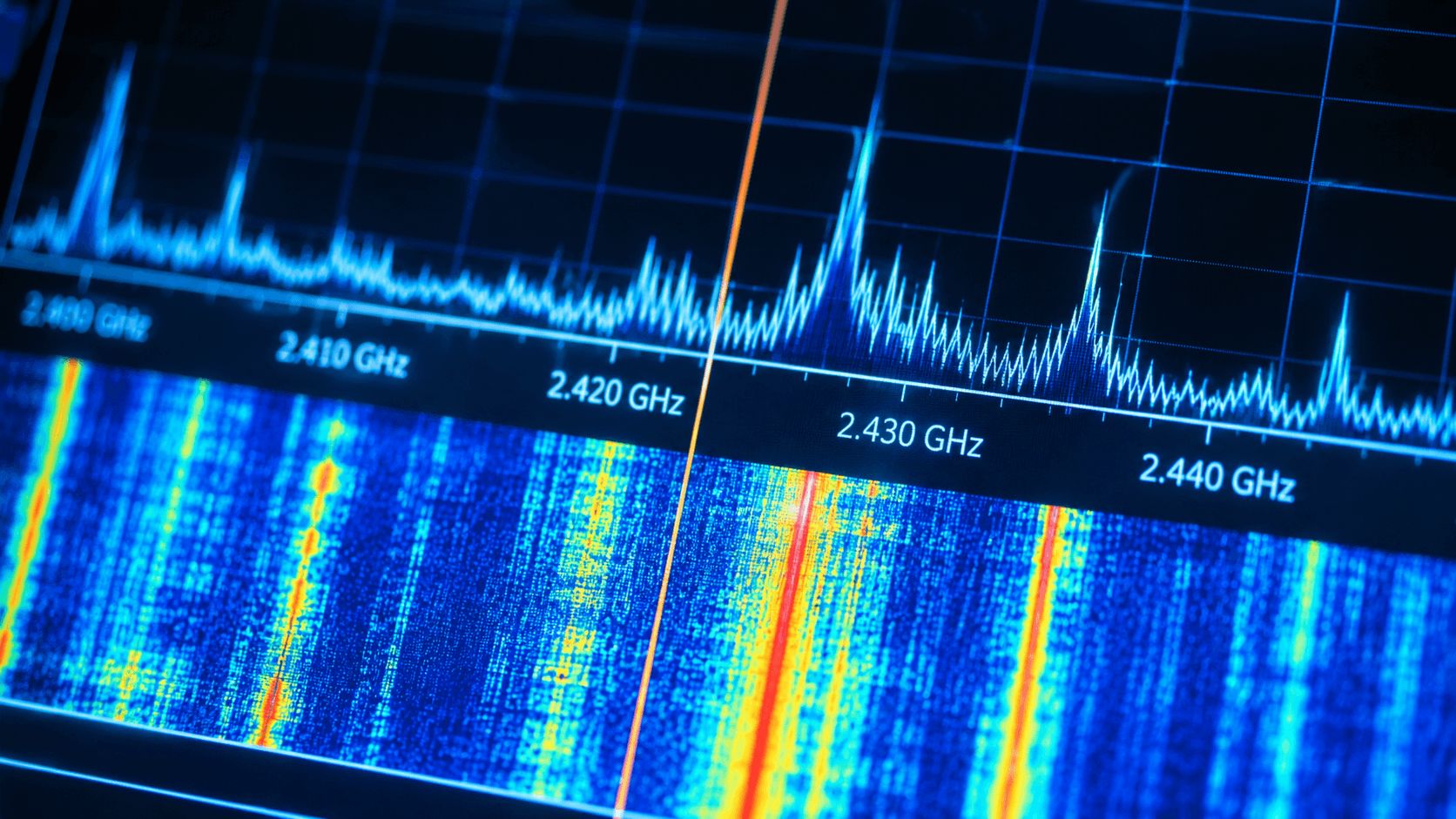
RFGPT is trying to close that gap. The model takes raw in-phase and quadrature radio waveforms, converts them into time-frequency spectrograms and passes those representations through a visual encoder. The resulting information is converted into what the researchers describe as RF tokens, which are then passed into a language model capable of answering questions and producing structured explanations about what it sees. RF-GPT research paper
In simple terms, instead of an engineer manually interpreting a complex spectrogram, the system can answer natural-language questions about which signals are present, the technologies transmitting them, how many signals overlap, and what is happening inside it. So instead of teaching AI another language, the researchers are attempting to give it another sense.
Early Research is Promising
When Khalifa University first announced RFGPT in April, it said the system had outperformed baseline models by as much as 75.4% on some radio-frequency spectrogram tasks and correctly counted the number of signals present approximately 98% of the time. Khalifa University
The underlying research tested the system across several types of wireless analysis, including modulation classification, overlapping signals, wireless-technology recognition, WLAN user counting and extraction of information from 5G NR signals. General-purpose vision-language models without RF-specific training performed poorly by comparison.
The research team generated standards-compliant radio scenes across technologies including 5G NR, LTE, UMTS, Wi-Fi, satellite communications and Bluetooth, then converted them into spectrograms and training examples. The research describes roughly 625,000 instruction examples produced without manual labeling. RF-GPT paper
Synthetic data solves a genuine problem in RF research because collecting and labeling large volumes of real wireless data is difficult and expensive. But it also creates another question: how well does a model trained on simulated spectrum understand an actual radio environment?
A separate 2026 study, RF-Analyzer, connected RF-aware vision-language models to live software-defined radio equipment and tested whether knowledge learned from synthetic spectrograms transferred to real over-the-air signals. The results were encouraging, but also exposed the limitations. RF-Analyzer research
The researchers found that RF-GPT could generalize reasonably well when identifying physical properties such as spectral occupancy, timing behavior, and signal-to-noise conditions; however, it struggled with interpretation.
The researchers identified a major issue for operators. In some real-world scenarios, the model could correctly recognize a signal's shape but assign the wrong wireless technology. The researchers found that synthetic training had not fully taught the model the contextual constraints of real frequency bands, and performance also weakened in low signal-to-noise environments that differed from the training distribution. RF-Analyzer
Bigger Opportunity is 6G
Looking at the future, this research becomes more relevant in direction of mobile networks. 5G networks already involve complex combinations of spectrum bands, antennas, devices and dynamic resource management. 6G research pushes much further toward networks that are expected to sense, predict and adapt to their environments continuously.
So a foundational model that learns the reusable RF representations could provide a common intelligence layer across different tasks.
A recent survey of wireless foundation models found growing evidence that reusable wireless representations can transfer across signal recognition, sensing, localization, channel modeling and spectrum-management tasks. But it also warned that the field remains fragmented, with different datasets and evaluation methods making it difficult to determine how well models will generalize outside controlled experiments. Wireless Foundation Models survey
Khalifa University's research has shown that a multimodal model can learn meaningful RF representations and answer natural-language questions about spectrum. The more consequential question is whether it can learn to understand the parts of that spectrum it has never seen before.
Related Articles
Google Adds Two New TPU Systems to Its AI Chip Portfolio
Dropbox Buys Tigris Data for $350 Million as AI Infrastructure Moves Into the Storage Layer
Snowflake expands AI governance tools to move enterprise agents into production