Big Tech
If Nvidia Can Make It, China Can Copy It, Cheap It, Crash It.

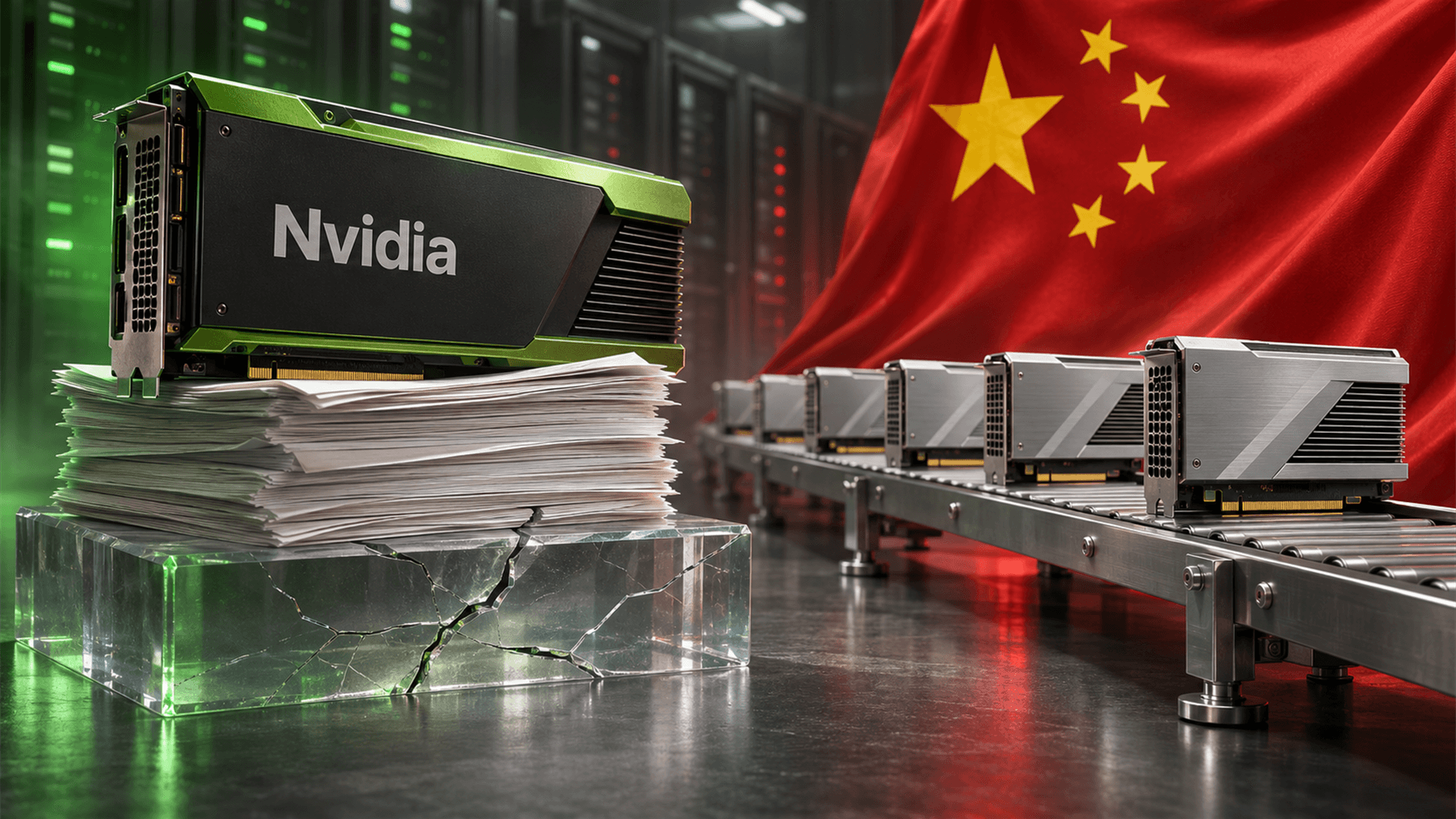
Cheaper AI could be good for users and brutal for the loans, leases and valuations built around today’s computing prices.
[For more news, click here]
Nvidia’s reported halt to server shipments into four Southeast Asian countries raises a question that reaches beyond lost chip sales: what happens to the financing behind AI infrastructure when the assumptions supporting its value change?
Nvidia has instructed manufacturing partners to pause shipments to Malaysia, Singapore, Thailand and Indonesia. Separately, Fitch warned that restrictions could squeeze over-leveraged and debt-financed computing providers through lower utilization, delayed revenue and tighter cashflows.
Companies have committed capital against expectations about future demand. Competition, regulation or technological progress could change those expectations before the obligations expire. China does not have to destroy demand for AI to damage that investment case. It just has to make computing cheap.
The Chips Got More Expensive. So Did the Bet.
Epoch AI’s hardware database puts selected Nvidia accelerator release prices at approximately $5,700 for the P100 in 2016, $15,000 for the A100 in 2020 and $43,000 for the GB300 in 2025.
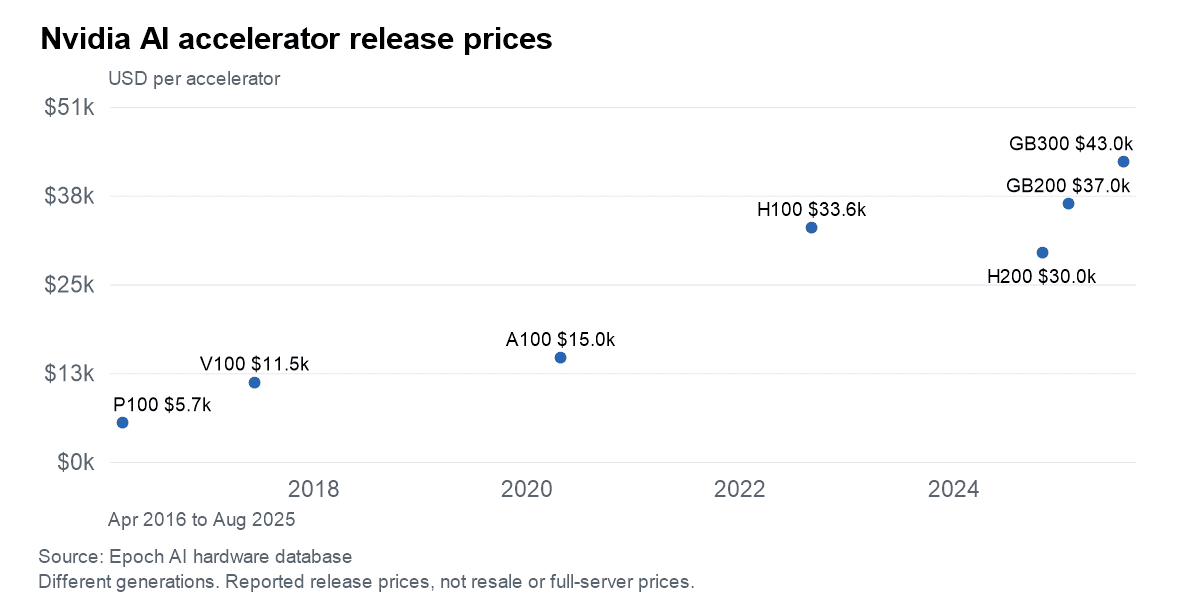
The rising ticket price increases the capital committed to each purchase, alongside networking, cooling and power. Buyers finance those commitments against expected computing income and the equipment’s recoverable value.
A more expensive successor does not make an older GPU appreciate. The risk is that infrastructure bought at today’s prices must compete with tomorrow’s cheaper computing while still carrying yesterday’s financing.
Chips for Shares - No Money Required
Nvidia invests in an AI company. That company purchases computing capacity. Infrastructure providers buy Nvidia equipment, supported by lenders, investors and long-term customer contracts. Money circulates through the ecosystem, generating chip revenue along the way.
OpenAI’s February funding announcement included $30 billion from Nvidia within a $110 billion round, alongside additional Nvidia computing capacity. In October, SpaceX announced a commitment for approximately $40 billion of GPU and equipment financing through an Apollo-managed entity, with closing expected before year-end and deliveries beginning in 2027.
Nvidia also disclosed $118 billion of maximum gross guarantee exposure, largely involving phased infrastructure support associated with OpenAI. These are contingent obligations that build over time; no guarantee payments had been made.
“Chips for shares” describes the economic loop. Real cash changes hands, but the supplier can become seller, shareholder and guarantor around the same expansion. If customer economics disappoint, several exposures can deteriorate together.
Eventually, spending from outside that loop must support the obligations inside it.
Falling Chip Values Can Erase Much More Than Equity
Consider a hypothetical business with $2 billion of assets: $1.2 billion of GPUs and $800 million of other assets. It owes $1.2 billion, leaving $800 million of economic equity.
If GPU values halve while other assets and debt remain unchanged, total asset value falls to $1.4 billion. Equity falls to $200 million.
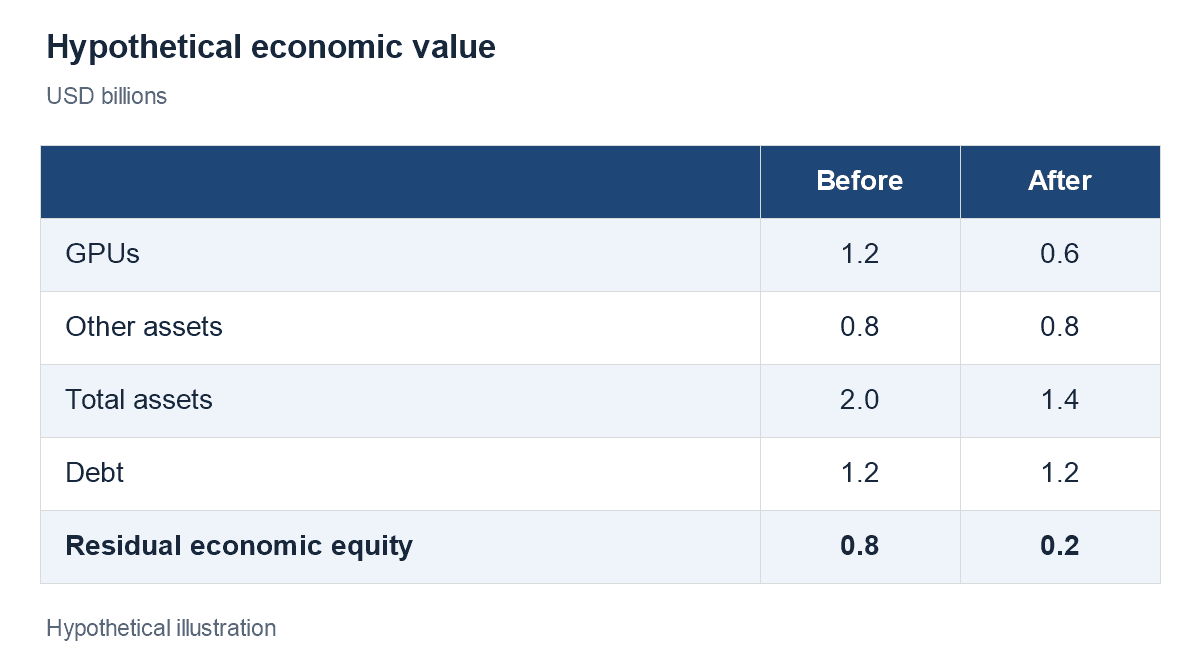
A 50% GPU-value decline produces a 30% total-asset decline and a 75% equity loss. Debt magnifies the damage because its claim stays fixed.
This illustrates leverage, not a price forecast or an automatic accounting write-down. For lenders, falling recovery values mean weaker collateral coverage and less refinancing headroom. Owners may need fresh equity even while the equipment continues operating.
The machines do not have to stop working for their financing to stop working.
The Loan Can Fail Before the Chips Devalue
Take another hypothetical operator with $100 million of annual revenue and $40 million of operating cash costs. It has $60 million available against $50 million of principal and interest payments.
Its debt-service coverage ratio is 1.20x: $1.20 available for every $1 due, leaving a $10 million cushion.
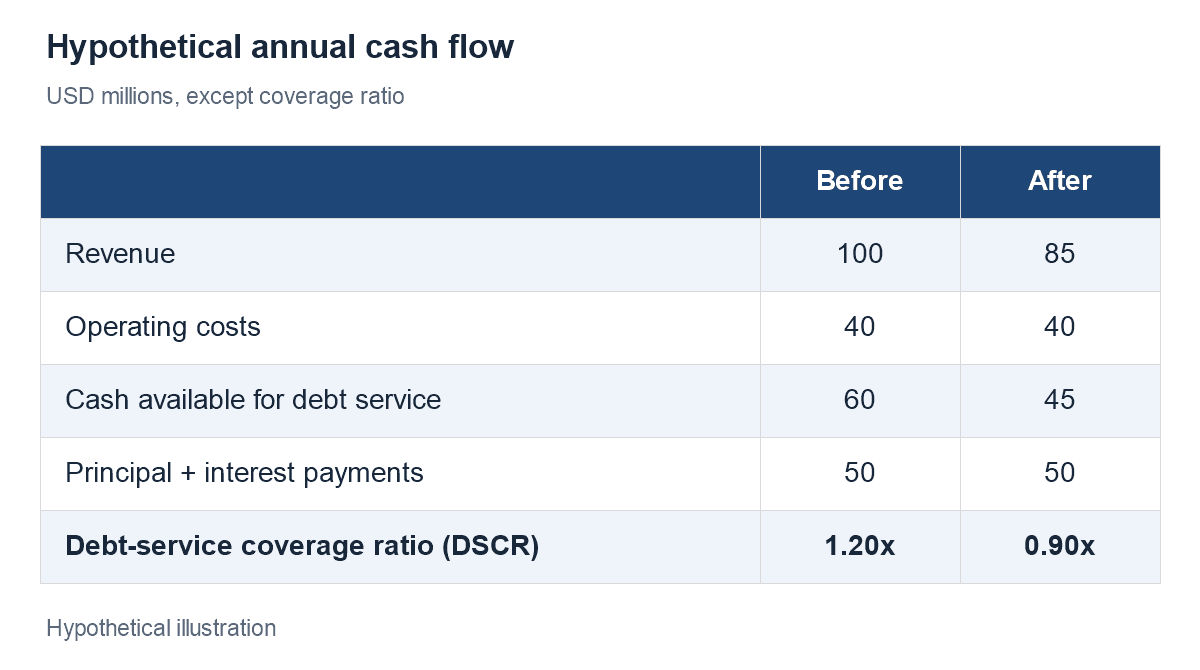
Now revenue falls 15% to $85 million. With costs unchanged, cash available for repayment falls to $45 million.
Coverage becomes 0.90x: 90 cents available for every $1 due, creating a $5 million shortfall.
Lower rental prices, fewer occupied GPU hours or delayed customer payments can produce that squeeze without a collapse in chip resale prices. Fitch’s warning concerns precisely these pressures on providers that need expensive equipment to remain heavily utilized.
Long-term contracts help only as far as customers can keep paying.
China Has Years to Get Cheaper. The Commitments Are Already Signed.
Anthropic’s November filing disclosed approximately $900.9 billion of committed spending, substantially all tied to computing and infrastructure. Around half falls before the end of 2030, with substantially all the remainder extending through 2045. Some arrangements contain termination rights or conditions.
One Amazon agreement commits Anthropic to at least $110 billion between May 2026 and April 2036, regardless of actual usage, subject to specified adjustments and exceptions. Spending below the commitment can require a payment covering the difference.
The hardware can change during those years. The obligation to spend remains.
Huawei’s announced roadmap puts Ascend 960 variants in 2027, Ascend 970 in 2028 and Ascend 980 in 2029. Multiple planned generations therefore fall inside commitments already signed by Nvidia’s customers and competitors.
China does not need to beat every Nvidia benchmark. It needs to make switching worthwhile for enough buyers. Competitive inference systems, improving software and cheaper architectures could pressure computing prices before China achieves comprehensive technological leadership.
Domestic manufacturing is advancing too. Reuters reported early production of Chinese immersion DUV equipment in July. Its earlier EUV investigation described a prototype generating light but not yet producing working chips, with a government target of 2028 and sources suggesting 2030. Those dates sit inside today’s infrastructure commitments.
Manufacturing yields, memory, software and electricity consumption will determine whether those systems are actually cheaper. Raw materials alone do not settle the argument: China dominates solar-grade silicon, but its semiconductor-grade polysilicon share remains below 10%, according to the OECD.
The investment risk is cumulative progress across the system. Today’s technical gap cannot be assumed to protect tomorrow’s margins.
Nvidia acknowledged the competitive consequence in its July filing, saying exclusion from China had:
“helped our competitors build larger developer and customer ecosystems to challenge us worldwide.”
Nvidia Can Keep Growing. Some of Its Infrastructure Bets Can Still Fail.
The latest restrictions introduce licensing requirements, including exceptions for qualifying US-headquartered recipients. They do not permanently erase every customer in the affected countries.
Nor does Nvidia depend entirely on China. Its November 17 outlook anticipated approximately $130 billion of quarterly revenue without Chinese data-center computing revenue.
Cheaper AI can also generate enough additional demand to support expensive infrastructure. Nvidia said on its November earnings call that token prices had fallen nearly 60% since May while B300 rental rates had risen more than 60% since introduction.
The question is where demand growth stops covering the commitments made against it. A profitable chip supplier can coexist with distressed borrowers using its products. Competition can come from China, US custom chips or Nvidia’s own next generation.
AI Adoption Grows as Its Early Investors Lose Money
Telecom already demonstrated this separation. Real consumption of telecommunications services rose from approximately $88 billion in 1995 to $151 billion in 2001 while profits deteriorated and investment collapsed. Lucent, which helped finance its customers, disclosed approximately $6.9 billion of customer credit and debt-guarantee commitments in 2001.
Solar supplies another example: the IEA reports that more than 90% of major Chinese solar manufacturers recorded losses in 2026 as overcapacity and falling prices squeezed margins, alongside continued expansion in global deployment.
A technology can succeed while the prices paid to finance its expansion prove disastrous.
For AI, weaker rental income could reduce debt coverage, refinancing and new equipment orders. Distressed owners may sell infrastructure to buyers with a lower purchase cost, allowing cheaper computing that puts further pressure on existing operators. Losses can then reach lenders and suppliers through loans, investments and guarantees.
Whether that becomes a wider financial crisis depends on how concentrated and interconnected those exposures are.
China does not have to make AI fail. It could help make AI cheaper before the people who financed its expensive beginnings have been repaid.
Related Articles
U.S. AI Chip Rules Tighten Overseas Access to Nvidia Computing
Jensen Huang returns to a different Nvidia and a different Washington
Oracle Reportedly Cancels $7B Tencent AI Chip Deal Amid US Pressure