Deep Tech
Impossible Metals tests AI-powered robot to collect minerals from deep ocean

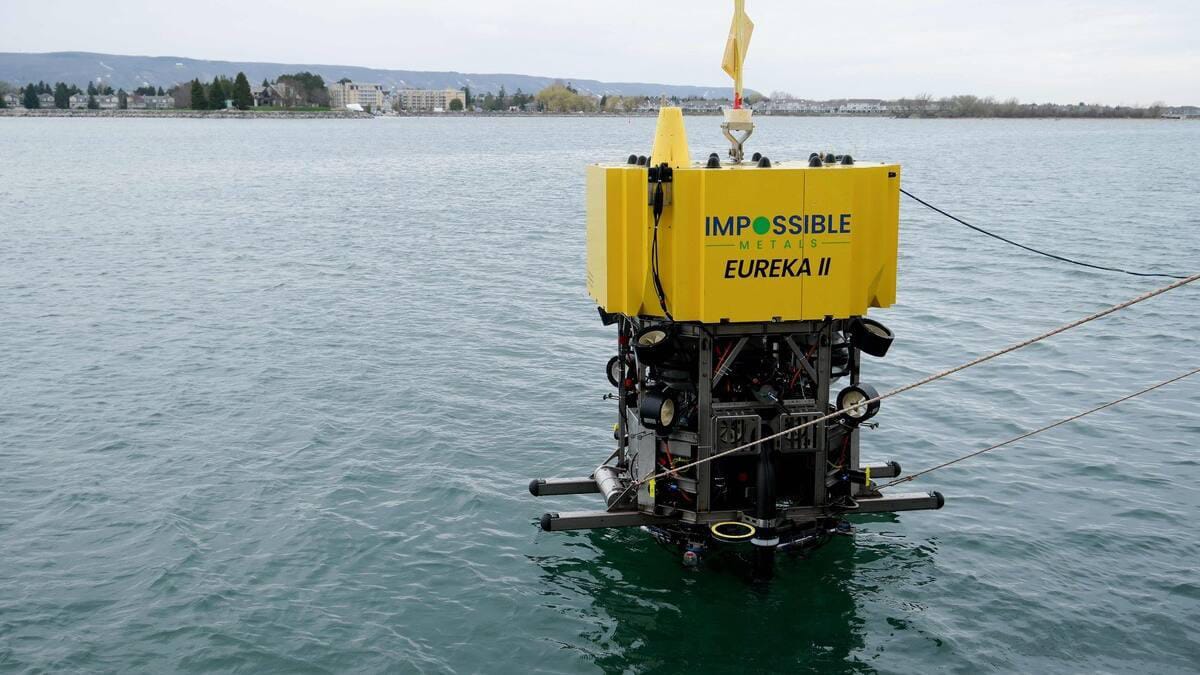
Impossible Metals says its autonomous underwater robot successfully recovered mineral-rich rocks from more than 4,000 meters below the Pacific Ocean.
(For more news, click here)
Deep-sea minerals are attracting attention as manufacturers seek new supplies of nickel, cobalt and copper for batteries and electronics. But collecting them from the ocean floor remains controversial because the environmental consequences are difficult to measure and existing extraction systems can disturb large areas of seabed.
Impossible Metals said that its autonomous Eureka Collection System successfully retrieved mineral-rich rocks from more than 4,000 meters below the Pacific Ocean. During a scientific expedition in September, the vehicle descended into the Clarion-Clipperton Zone, collected approximately 450 grams of polymetallic nodules and returned to the surface.
The company describes the trial as a first for selective nodule collection by a fully autonomous underwater robot, although it was a research-scale demonstration rather than a commercial mining operation.
How the robot collects minerals
Polymetallic nodules are rounded deposits lying on the seabed that contain metals used in industrial equipment and electric vehicles. Many proposed mining systems use large collectors and pipes to move nodules toward a surface vessel, potentially stirring up sediment as they travel across the ocean floor.
Impossible Metals takes a different approach. Eureka hovers above the seabed instead of driving across it, using onboard perception systems to identify individual nodules and visible marine organisms nearby. Robotic arms select rocks that the system determines can be collected, leaving others in place. A buoyancy mechanism brings the vehicle and its payload back to the surface without a continuous pipe connecting it to the ship.
The design is intended to limit direct contact with the seabed and reduce sediment disruption. Those are company claims, however, and the small amount collected in September does not establish how the technology would perform across thousands of tonnes of material or over extended operations. The recovered nodules will go to research partner Viridian Biometals, which is studying bacteria associated with them and potential biological approaches to extracting metals.
Environmental questions remain
The mining debate goes beyond how a robot moves. Nodules themselves provide habitat for organisms living on the deep seabed, and collecting a rock can remove that habitat even when no visible animal is detected on its surface. Industrial activity may also affect sediments and ecosystems over time.
A study published in Nature in 2025 found that signs of physical disturbance and changes in animal communities remained visible 44 years after an experimental mining operation in the same broader Pacific region. The research also recorded some biological recovery, underscoring why scientists are studying both the severity and duration of ecological effects.
Impossible Metals says it will submit a larger Eureka III robot for assessment by an independent scientific team aboard Germany's RV SONNE in 2027, as part of an environmental study initiated by Germany's Federal Institute for Geosciences and Natural Resources. The planned assessment is not equivalent to an environmental clearance for commercial mining.
Funding and regulatory hurdles
The company also disclosed that relatives of FedEx founder Fred Smith participated in its Series A financing, which closed earlier in 2026. Reuters reported that the investment amount was not disclosed; media estimates placed the round near $25 million, but those figures are not company-confirmed.
Regulatory uncertainty remains a significant obstacle. The International Seabed Authority says it has not authorized commercial mineral extraction in international seabed areas while rules are still being developed. The United States, which is not a party to the UN Convention on the Law of the Sea, has a separate permitting process through NOAA, although an application review does not constitute permission to begin commercial mining.
Impossible Metals CEO Steve Curnutte said the next challenge is “scaling and manufacturing, not invention.” That assessment will face a significant test as the company moves beyond recovering hundreds of grams. Commercial viability will depend on whether selective collection can operate efficiently at scale while meeting environmental and regulatory requirements.
The September test demonstrates that autonomous robots can selectively recover minerals at extreme ocean depths, offering a potential alternative to conventional seabed collection methods. For the deep-sea mining industry, the outcome is an early technical milestone rather than evidence of commercial viability. Whether selective robotic collection can become a practical alternative will depend on its ability to recover minerals at scale while limiting environmental damage and meeting regulatory requirements.