AI
Jordan Is Building More Than an AI Campus. It Is Building the Stack Around It

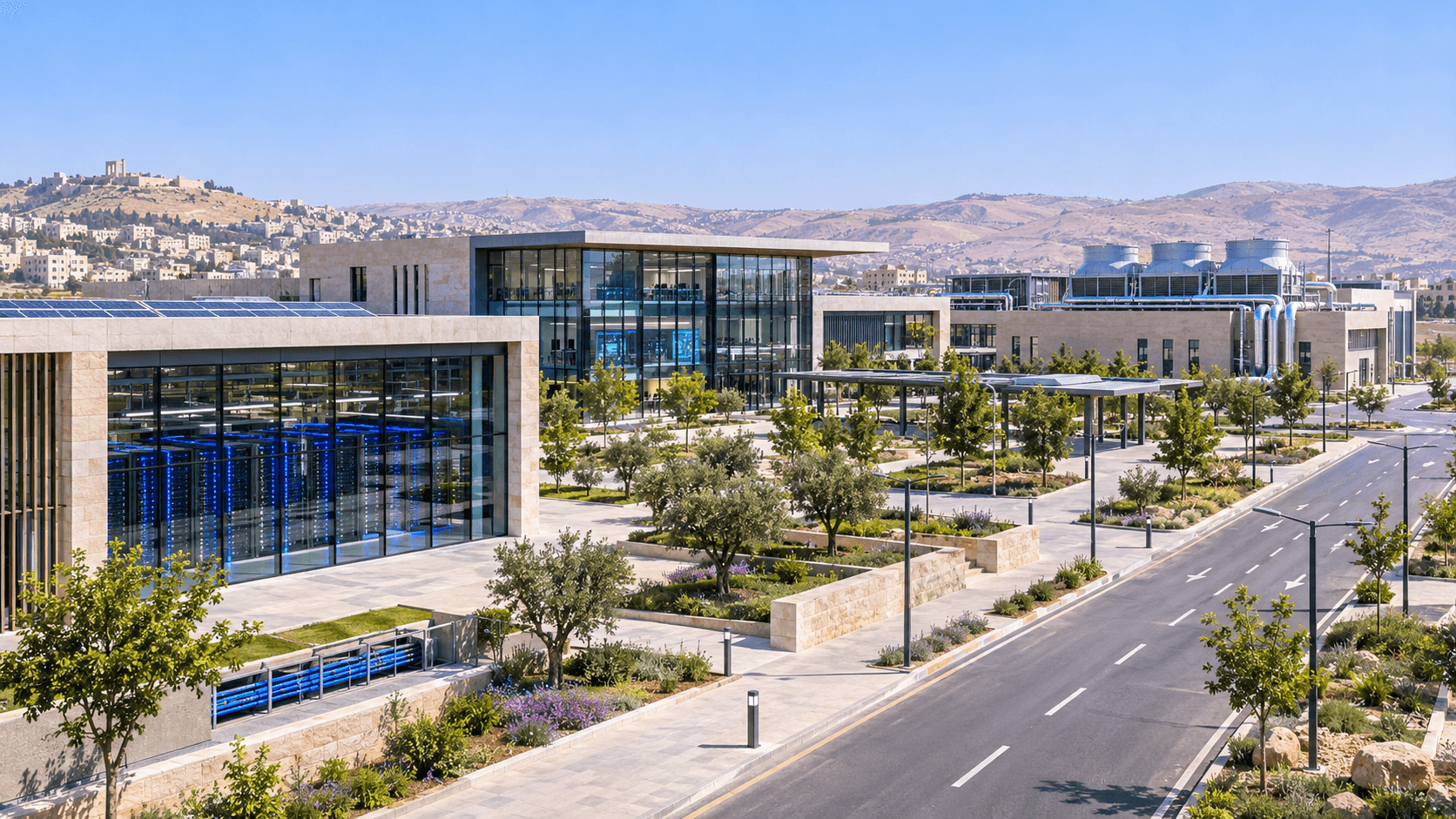
Jordan has unveiled a new wave of technology investments spanning fiber optics, AI data centers, sovereign cloud, semiconductors and advanced research. The package includes a $142 million fiber-optic manufacturing plant and a 400MW AI campus in Risha, with the first 70MW targeted for Q2 2027.
[For more news, click here]
The Middle East’s competing for what lies beneath the models of AI. Each element is important: compute, power, fiber, cloud capacity, local manufacturing, and the ability to keep sensitive workloads within national infrastructure. Jordan is now trying to build more of the layers at once.
At the Jordan-EU Investment Conference, the government announced a package of technology projects spanning AI, data centers, semiconductors, cloud computing, advanced manufacturing, and applied research, aimed at expanding domestic technology production and creating more skilled jobs.
The announcements include a $142 million investment by TechLine to establish a fiber-optic manufacturing plant, while Mindstream Energy is advancing plans for an AI infrastructure campus in Risha with capacity of up to 400MW.
Mindstream plans to bring the first 70MW online in the second quarter of 2027, using natural gas available at the site to generate electricity for the campus.
Fiber Moves Into the Industrial Layer
TechLine’s $142 million commitment is significant because it adds a manufacturing layer to Jordan’s digital infrastructure strategy. The planned facility will produce optical fiber preforms, the glass rods used to draw optical fibers. Petra says it has already ordered the plant’s equipment.
That places Jordan in a part of the telecom supply chain that gets less attention than data centers or cloud platforms, even though AI infrastructure relies heavily on high-capacity connectivity.
Large compute clusters need fast links between servers, data centers and external networks. As AI models become larger and distributed across more infrastructure, fiber becomes part of the performance equation.
The investment therefore connects two sides of the same strategy. Jordan is trying to increase compute capacity while also building more connectivity infrastructure to support it.
The Risha AI Campus Will Turn Energy Into Computing
The Mindstream Energy campus in Risha highlights how closely AI infrastructure is tied to energy. Mindstream first announced the project in July, with plans for up to 400MW of AI and high-performance computing capacity. The November announcement provides a clearer deployment timeline, targeting the first 70MW for Q2 2027.
The site is designed around a simple principle: place compute where energy is available. Rather than treating electricity as an external input, the campus plans to use local natural gas resources to support on-site generation.
As data centers scale to hundreds of megawatts, access to the grid is becoming a major constraint on expansion. Operators are increasingly seeking ways to bring power closer to compute instead of waiting for transmission capacity to come online.
Jordan’s Risha project gives this strategy a regional dimension and sets the country apart from larger Gulf markets. Jordan cannot compete with Saudi Arabia or the UAE on the sheer amount of capital available. Instead, it can compete through its location, energy access, connectivity, and ability to link infrastructure with regional demand.
Sovereign AI Is Part of the Same Buildout
Jordan is also developing a separate sovereign AI layer. NexusIgnite is planning a sovereign AI cloud for Jordanian universities, designed to give researchers access to advanced computing while keeping research data inside the country.
The service is expected to launch in 2027 using AMD Instinct processors and is initially intended to support around 200 university researchers. Sovereign cloud determines who controls access to that capacity, where the data sits, and whether institutions need to move sensitive workloads onto foreign infrastructure. For universities and research institutions, that can affect everything from scientific data to intellectual property.
The AI Campus Strategy Involves Different Campuses
The Risha project is not the only AI campus moving forward. NUJUM16 is advancing a separate AI campus and center of excellence in Jizah.
The project is designed to combine computing infrastructure, applied research, education and technology services. NUJUM16 says its campus is planned to scale to 100MW, with initial service beginning in 2027.
It has also signed partnerships with Al Hussein Technical University, MDCS.AI and Lorentz Centers, linking compute infrastructure with training, research and sovereign AI applications.
Semiconductors Are Entering the Strategy Too
Jordan is also trying to move further upstream. The Ministry of Digital Economy and Entrepreneurship and the International Finance Corporation are working on a $1.41 million semiconductor development program through the end of 2027.
The program will develop an investment proposition for the sector, design incentives and help government agencies attract international chip companies. The current initiative is exploratory and investment-focused.
But its inclusion alongside fiber manufacturing, AI data centers and sovereign cloud is significant because it shows the government is thinking about the technology stack more broadly.
The objective appears to be less about owning every layer immediately and more about identifying which parts Jordan can realistically build, manufacture or host locally.
Jordan Is Building a Complete Digital Infrastructure Stack
The Umniah by Beyon Delmon Data Center, a JD9 million project, is designed to become Amman’s largest Tier III facility and expand cloud and hosting capacity for government, financial institutions and businesses.
Together, the projects cover connectivity, compute, sovereign cloud, research, data centers and early semiconductor development.
Jordan is building several smaller, interconnected layers that could help the country join the regional AI economy without matching Gulf spending project by project.
The strategy could also give Jordan something increasingly valuable: domestic capability. If fiber components are manufactured locally, computing is hosted locally, research data stays within the country, and engineers are trained to work with the infrastructure, more of the value chain remains in Jordan.
Related Articles
Data Center World Makes Middle East Debut as Gulf AI Infrastructure Build-Out Accelerates
Du Launches National HyperAI Across Five UAE Data Centers for Sovereign AI Workloads
Vodafone, Elsewedy and Cassava Plan $1 Billion Data Center Expansion in Egypt