MENA News
MCAIT 2026 Brings Arabic AI and Applied Research to Madinah

The conference's first edition outside Malaysia features 142 accepted papers from researchers representing 98 universities across 37 countries.
For more news, click here
Developing useful AI for Arabic-speaking communities involves understanding local language and context. Applying it in healthcare, public services and business requires evidence that systems can perform reliably in the settings where people will use them. Those questions were up for discussion at MCAIT 2026.
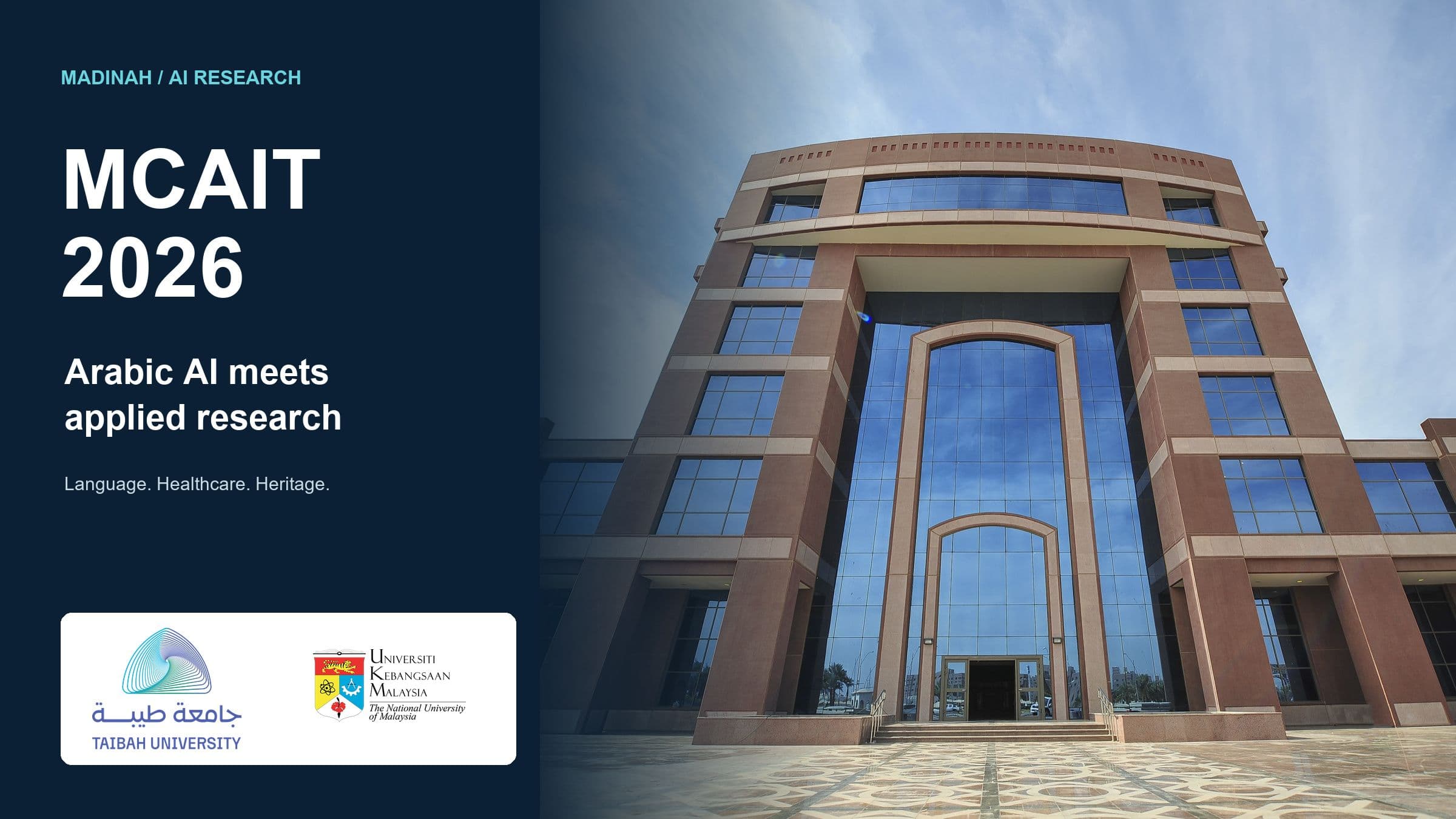
The sixth International Multi-Conference on Artificial Intelligence Technology is taking place in Madinah from November 3 to 5. Hosted by Taibah University in partnership with Universiti Kebangsaan Malaysia (UKM), the hybrid event connects AI research with applications across language, health, cybersecurity and smart cities.
The conference accepted 142 papers from researchers representing 98 universities across 37 countries, following scientific review of more than 200 submissions, according to the Saudi Press Agency. The submissions give the meeting an international research base alongside its Saudi and Malaysian institutional partnership.
Holding the conference outside Malaysia for the first time marks a milestone in the partnership, UKM faculty dean Professor Shahrul Azman Mohamed Noah said in SPA's opening report. Its program includes 25 parallel sessions and six keynote speakers across five research tracks.
Arabic AI in its local context
Arabic language technology is one of the clearest regional threads. King Saud University Professor Hend Al-Khalifa's keynote, titled "Arabic Lives in People, Not in Tokens," connects natural language processing with the sciences of language, mind and society. The framing puts people's use of language at the center of model development. Official speaker profile.
The technical program includes a human-validated Saudi Arabic intent benchmark evaluated across dialects and model families, alongside research on Arabic silent speech recognition. These topics address different parts of the same challenge: building systems that can interpret the ways people communicate.
The deployment question also appears in the keynote program. HUMAIN researcher Dr. Sakhar Alkhereyf's session focuses on taking large language models into production, while Imperial College London's Professor Islem Rekik addresses inclusive, equitable and safe AI. Together, those subjects connect model capability with the conditions required for practical use. Official keynote program.
Healthcare, heritage and the limits of performance
Research reported during the conference gives those discussions a practical setting. One study analyzed about 22,000 labeled Arabic texts to identify linguistic indicators associated with depression, reporting 95.85% accuracy. SPA also described research work on heart rhythm classification, lung tissue classification and preliminary malaria detection. SPA's second-day report.
An accepted study compares an AI approach called offline reinforcement learning with clinicians' insulin dosing decisions. Its title reports that the AI did not do better in the intensive-care patients studied. The comparison highlights why AI should be tested against existing medical practice.
Beyond healthcare, the technical schedule lists research on using vision-language models to detect cracks in heritage structures at Al Qattara Oasis in the UAE. It is a distinctive regional application, bringing AI evaluation into cultural preservation. Other sessions explore prompt-injection defenses for AI agents. This addresses security risks for organizations using automated tools. Official technical schedule.
Practical training accompanies the research sessions. The workshop program covers AI-supported organizational workflows and Transformer-based language applications, including an NVIDIA Deep Learning Institute workshop. This gives the conference a skills component alongside its research presentations.
MCAIT's move to Madinah brings an established Malaysian conference series into a Saudi academic partnership. This is a program grounded in recognizable regional needs. Its wider value will depend on how research relationships and experimental work develop into the tools that perform reliably.