Cybersecurity
FinCEN's Hack Tests Resilience of Global Financial Intelligence


Disrupted reporting at the US financial intelligence agency exposes the stakes of keeping essential services working as AI expands the capabilities available to attackers.
[For more news, click here]
The Financial Crimes Enforcement Network, or FinCEN, is a critical hub in the US financial system's defenses against money laundering, fraud and terrorist financing. The Treasury bureau collects financial intelligence, supports investigations and authorities abroad. It has now taken certain systems offline after unauthorized access to part of its network. On November 25, US banking regulators issued protection for eligible institutions facing disruption-related reporting delays. Regulatory statement
That brings the incident into the conversation Tech Revolt has followed through cloud outages, delayed bank transactions and suspended court deadlines. Our coverage of the Binance theft and international recovery effort shows why the response to a financial cyberattack extends beyond securing the breached network. Investigators must follow stolen money across platforms and borders, supported by timely information and cooperation. FinCEN supplies financial intelligence that helps authorities pursue such crimes. Disruption at an institution performing that function can therefore matter well beyond Washington.
AI Is Widening the Threat
FinCEN's initial access method, the attacker's identity and any use of AI remain a mystery. The broader threat environment nevertheless explains why institutions cannot assess preparedness only against yesterday's attacks.
In September 2026, Anthropic reported tests of GLM-5.3, a Chinese-developed open-weight model, that produced working exploits for software vulnerabilities in controlled environments. The company also found its safeguards could be bypassed or altered.
Earlier UK AI Security Institute evaluations found leading open-weight models approaching the cyber capabilities of closed models released four to seven months before them. Downloadable weights support private deployment and independent research, but they also allow copies to operate beyond a provider's monitoring and account controls. Open-weight availability is not identical to an open-source software license, and openness alone does not establish malicious use. But it does prove the possibility exists.
There is already evidence of operational misuse. In a campaign disclosed in November 2025, Anthropic said attackers manipulated Claude Code to attempt intrusions into roughly 30 organizations, succeeding in a small number. It attributed the operation to a Chinese state-sponsored group and estimated that AI performed 80% to 90% of the campaign. Human direction remained necessary, and the model sometimes made errors.
Agents can connect reconnaissance, code generation and analysis into repeatable workflows, reducing the human attention needed for parts of an operation. That can increase the work an attacker attempts. It does not mean every AI-assisted attempt succeeds. Repeated attempts can nevertheless give attackers more opportunities to find an exploitable weakness, increasing the pressure on defenders to detect and contain them quickly.
Computing access is part of this picture. As Tech Revolt's Nvidia coverage explains, overseas computing arrangements can give restricted users access to advanced processors without importing the chips. US controls address specified arrangements, while a November 17 Justice and Commerce statement described the continuing Megaspeed diversion investigation. Separately, a company and its owner pleaded guilty in a scheme involving at least $160 million in Nvidia GPUs exported or attempted for export illegally. Justice Department
Russia-related enforcement provides another example of technology moving through intermediaries, although the documented cases include broader semiconductors and microelectronics. The relevant lesson is that institutions must prepare for capable tools becoming more widely accessible, alongside efforts to enforce technology controls.
What Depends on FinCEN
FinCEN helps connect information that individual banks may see only in fragments. Suspicious activity reports can supply leads and support existing investigations. Its role is financial intelligence and enforcement of anti-money-laundering requirements, rather than operating every bank's cybersecurity defenses.
In fiscal 2025, it received 4.8 million suspicious activity reports and 21.5 million currency transaction reports. Some 464 US agencies had access to its BSA Search tool. FinCEN also recorded 1,131 incoming requests from foreign financial intelligence units and 539 outgoing requests. These are measures of its workload and reach, not counts affected by this incident. FinCEN annual review
FinCEN has already acted against financial networks handling proceeds from major crypto thefts. In October 2025, it finalized restrictions cutting Cambodia-based Huione Group off from US correspondent banking access. Its analysis identified approximately $35 million flowing to Huione from the DMM Bitcoin theft, alongside approximately $2.6 million combined from the Atomic Wallet, Coinspaid and Alphapo heists. The action demonstrates FinCEN's practical role: identifying where stolen money moves and restricting the financial channels used to launder it. That gives its intelligence work consequences for exchanges, banks and victims across jurisdictions. FinCEN's final rule
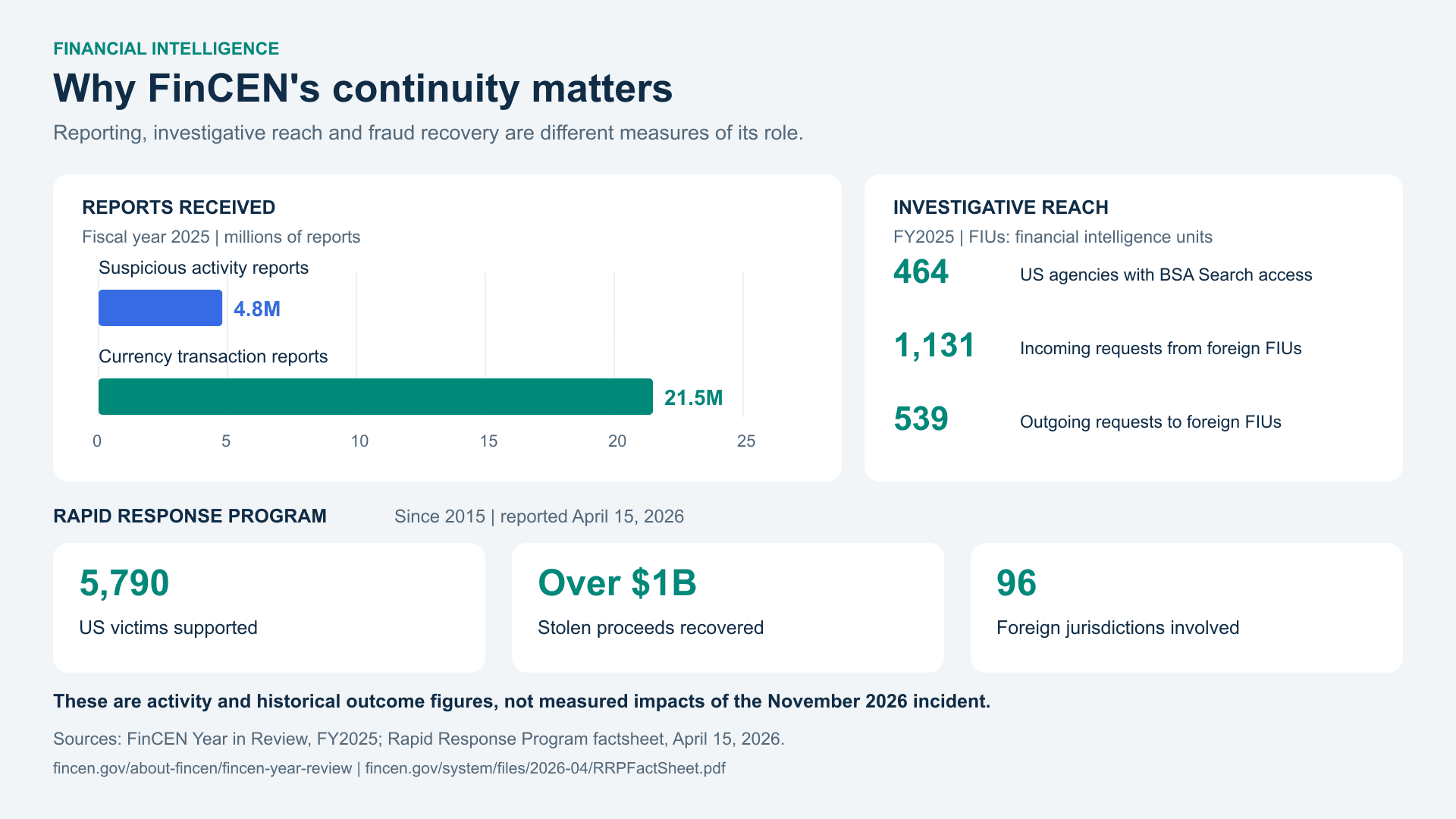
The consumer connection is tangible. FinCEN's Rapid Response Program works with law enforcement and foreign counterparts to recover fraud proceeds sent abroad. By April 2026, it reported recovering over $1 billion for 5,790 US victims since 2015. Its factsheet says interception or recovery is most likely when fraudulently induced wire transfers are reported to law enforcement within 72 hours. There is no verified evidence that this program was disrupted here, but it demonstrates why timely information matters. Program factsheet
A Cyber Incident Becomes a Global Problem
Treasury is working with the FBI, CISA and outside forensic examiners to determine the intrusion's scope and impact. A person familiar with the matter told Reuters there was no evidence of a breach of the Bank Secrecy Act or beneficial ownership databases. That remains a provisional assessment during an ongoing investigation.
A FinCEN official told Reuters:
"As a proactive measure, we have taken certain FinCEN systems offline"
The operational consequence is documented. FinCEN's November 24 order extends qualifying reporting deadlines otherwise falling between November 18 and December 29 to December 30. It covers eligible users of its automated SDTM filing channel, certain beneficial ownership reports and FinCEN identifier updates. Other anti-money-laundering obligations, including monitoring suspicious transactions, continue. Official order
The Outlook crash had institutional as well as technical consequences. Brazil's National Justice Council paused procedural deadline counting for November 12 and 13 after Microsoft 365 instability compromised judicial communication and work tools. Counting resumed November 16. The order protected parties from deadlines running during disruption. Our follow-up on global technology failures examined how that outage reached judicial administration.
Neither incident needs a confirmed theft to matter. Delayed submissions, interrupted communication and altered schedules can create work and uncertainty for institutions and the people relying on them. No verified public total establishes how many consumers, investigations or dollars were delayed by the FinCEN disruption. Yet, even without a total, the altered reporting deadlines establish an operational consequence.
Preserve Essential Work While Containing Damage
One useful feature of FinCEN's response is that its Financial Institutions Hotline remained unaffected. Institutions could still expedite suspicious activity information to law enforcement. That demonstrates a surviving urgent-reporting route, although a hotline cannot be assumed to replace automated filing capacity.
Its availability does not prove separate networks or show how attackers were contained. It illustrates the outcome institutions should design for: the ability to disconnect a risky service while essential work continues through another route.
FinCEN supplied a clearer historical example in 2005. After its externally hosted QuikNews mailing service was compromised, the bureau said the service was outside its security perimeter and unconnected to other FinCEN systems. It reported that internal sensitive information remained secure, although precautionary maintenance still disrupted some services. That documented separation illustrates the principle, without establishing today's architecture. FinCEN's September 2005 update
Isolation restricts the paths through which an attacker, compromised account or faulty service can affect other systems. This requires more than putting applications on different servers. Shared administrator accounts, sign-in services, network connections or recovery tools can leave apparently separate systems exposed to the same failure.
Microsoft's preliminary account showed the reliability equivalent. Its normal partition barriers failed to stop a cascade as traffic moved onto surviving infrastructure. The triggers differ, but the resilience question is shared: do boundaries hold when systems are under stress?
Audit the Ability to Keep Operating
Our recommendation is to audit complete services, including their dependencies, rather than judge resilience by the number of security products installed. For an institution such as FinCEN, that means examining report intake, intelligence storage, analyst access, administration, emergency communication and recovery together. These are review priorities, not findings that its existing controls are absent.
The sovereign-stack approach asks who can operate, inspect, isolate, repair and replace each layer. Data location and national ownership are only part of that control. Operators also need authority over permissions and encryption keys, dependable computing and connectivity, maintainable software and recovery arrangements that survive disruption.
As our coverage of AI-agent security risks explains, access reviews must account for automated systems as well as people. Reviews should cover suppliers, service accounts and AI agents alongside employees. Each needs permissions proportionate to its task, with selective revocation and auditable activity. Systems inside a national or organizational boundary should not receive automatic trust.
Recovery exercises should test a compromised administrator, unavailable sign-in service, disconnected filing channel and sudden backlog. Teams need to know which functions continue, who can authorize isolation and how restored services handle waiting work. Protected backups and recovery credentials should survive the same incident that disables production.
For leaders, useful evidence includes restoration times, delayed submissions, the age of the oldest urgent item and the capacity of alternative channels. An extended deadline can protect institutions from unfair penalties while unresolved processing work still requires attention.
The GCC offers relevant approaches. In the UAE, the Cyber Security Council's agreement with Siemens Energy proposes security testing, incident simulations, skills development and a possible National OT Cyber Lab. In Saudi Arabia, Saviynt's locally hosted identity-security deployment illustrates efforts to combine access governance with domestic data residency. The Kingdom's new cybersecurity center in Riyadh also focuses on identifying vulnerabilities, detecting threats and supporting continuity. For institutions such as FinCEN, the applicable lessons are rehearsed response, controlled access and continuous monitoring, with local hosting forming one part of the wider security architecture.
Resilience Must Keep Pace With Capability
As our Binance investigation explains, the exchange's preliminary account of its $6.34 billion theft described stolen deployment credentials reaching a wallet-signing service. Suspending withdrawals did not automatically revoke permissions attackers had established elsewhere. The scale of that loss makes access boundaries and tested containment an immediate financial concern. FinCEN's disruption extends the resilience question to the intelligence infrastructure that helps authorities pursue financial crime.
We are entering a period in which institutions must prepare for capable attacks as a recurring operating condition. People should protect credentials, verify financial requests and scrutinize how organizations handle their information. They also need institutions that invest in the controls individuals cannot provide for themselves.
That responsibility belongs in budgets, procurement, maintenance and leadership accountability. Privacy, financial security and continuity depend on critical systems being updated, tested and recoverable. The ability to discover a weakness faster must be matched by the ability to fix it and contain its consequences.
We cannot keep expanding what AI can do while allowing the infrastructure supporting banks, public services and everyday economic life to fall behind the threats those same capabilities can enable. Cybersecurity investment must grow with capability, and its value must be demonstrated in essential work that survives an incident.
Related Articles
Arkéa Cyber Theft Exposes Wider Risks to Digital Finance
An Exposed Server Revealed How a Ransomware Affiliate Used AI to Plan Attacks
Exclusive: AI Agents to Cause 25% of Enterprise Breaches by 2028