MENA News
Qatar Is Investing in Rare Earths and AI Chips. Is It Competition for China or Classic Washington Appeasement?

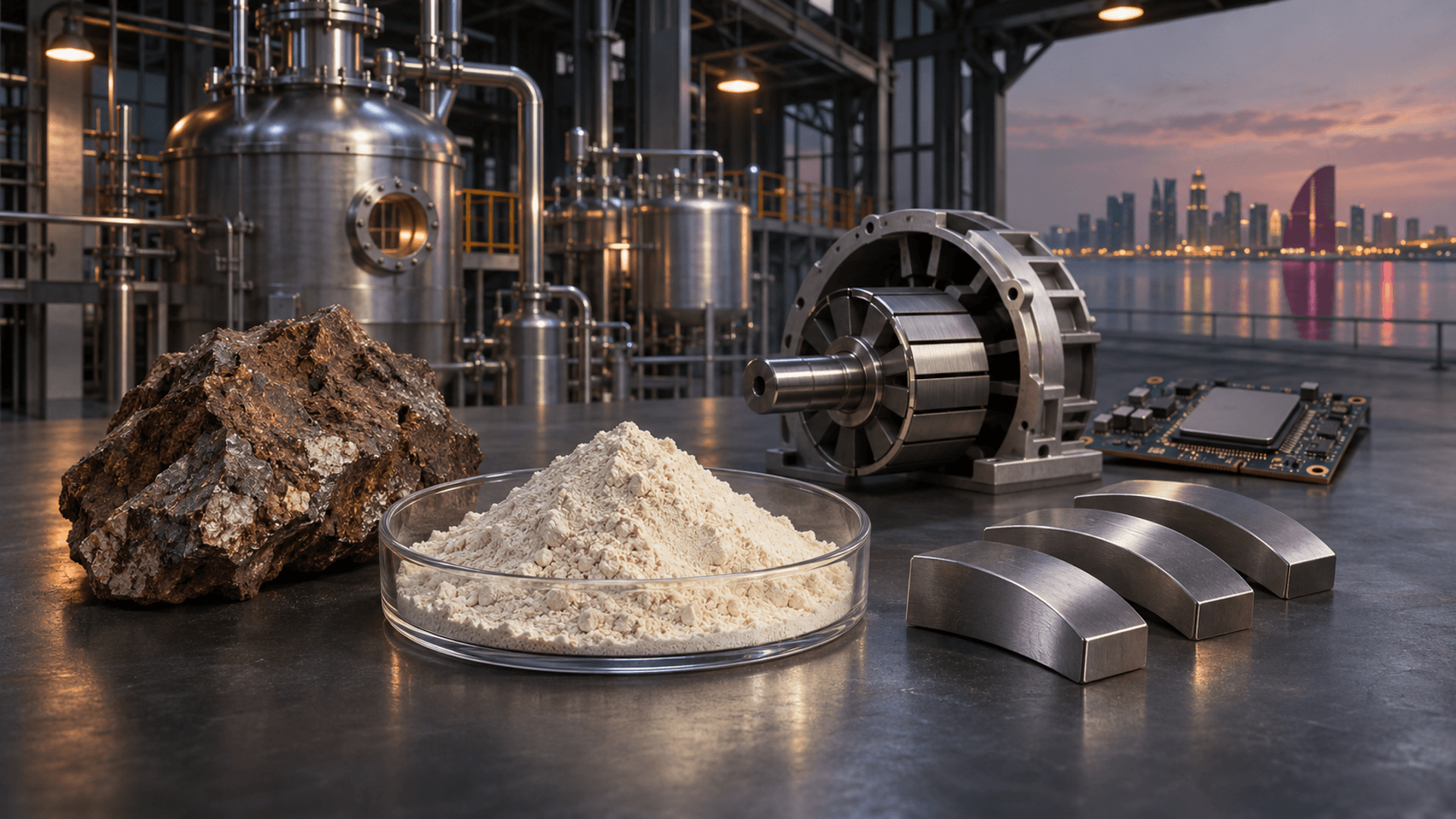
China mines 60% of the world’s rare earths and 91% of their refining. That gap helps explain why rare-earth processing is an investment opportunity for Qatar.
[For more news, click here]
Chinese magnet shipments to the US recovered after the US-China trade-war. The materials needed to make them stayed harder to get, opening a market for sizeable investment in processing. Taking advantage of the opening, Qatar and the United States signed an AI Acceleration Partnership and a Critical Minerals Framework at their latest strategic dialogue in Washington. This marks a milestone in Qatari investments in mineral processing, cementing an investment direction for decades to come. The AI agreement covers advanced semiconductors and digital infrastructure. The minerals framework calls for cooperation on processing and encourages joint investment.
The agreements fit the Trump administration’s push to attract investment from Gulf allies. The commercial opening for Qatar comes from what happened when China restricted rare earth exports. American buyers lost much of their supply of Chinese magnets almost overnight. When those shipments recovered, some of the materials needed to make the same magnets outside China were still hard to get.
What the Tariff Fight Exposed
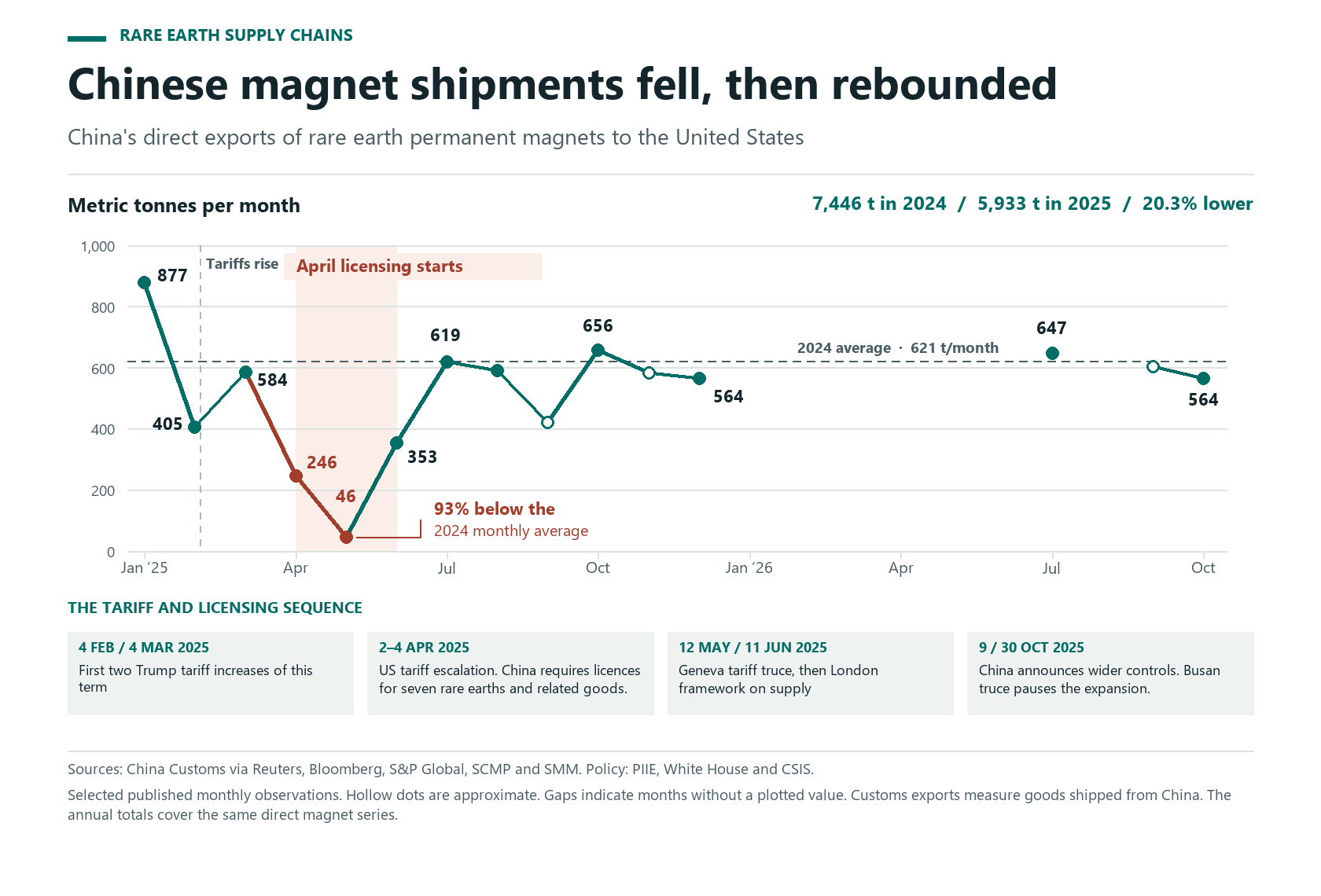
After Washington escalated tariffs, Beijing required export licenses for seven rare earth elements and certain products containing them. Direct Chinese shipments of permanent magnets to the United States fell to 46 metric tons in a single month, about 93% below the monthly average in the year before the restrictions. A tariff truce in Geneva and a follow-up agreement in London helped restore flows. Two months after the low, shipments were back to 619 tons. Even with that rebound, direct shipments for the full year fell about 20% to 5,933 tons.
Beijing later announced wider controls and suspended them under the Busan truce. It recently extended that pause, while the original licensing requirements stayed in place. In the 11 months following Busan, U.S.-bound shipments of a basket of controlled compounds and metals averaged 19.3 metric tons a month, down from 76.8 before the original controls. The basket includes dysprosium and terbium, both used in high-performance magnets. In a separate comparison of two eight-month periods, yttrium shipments fell from 333 tons before the restrictions to 17 afterward.
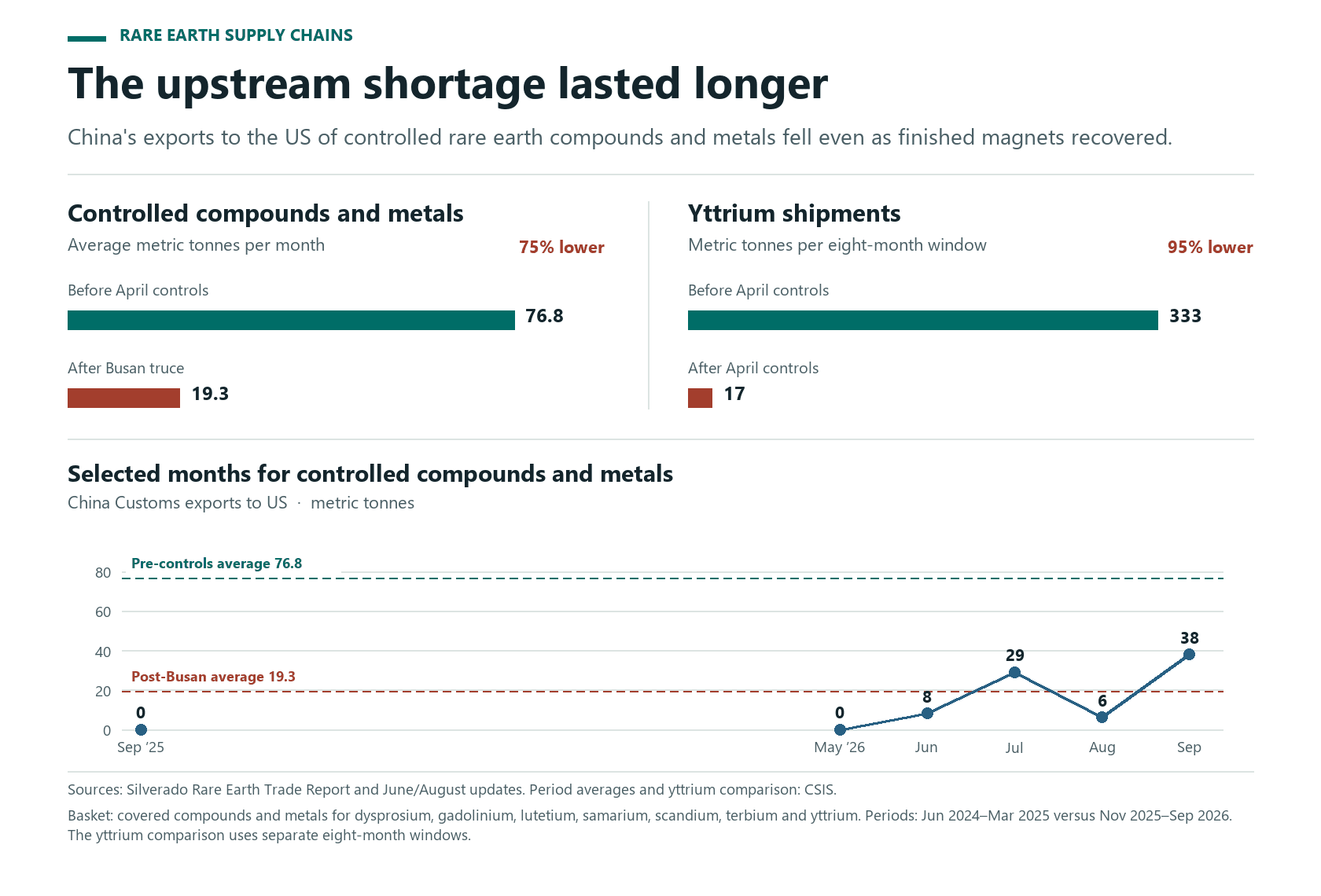
A manufacturer that can import a finished magnet can keep using it. A factory trying to make those magnets outside China needs a steady supply of the separated materials and alloys that go into them. The recovery in finished magnets did little to solve that factory’s sourcing problem.
China’s Lead Grows After the Mine
The International Energy Agency puts China’s share of mined output for four magnet rare earths at 60%. That rises to 91% in refining and 94% in the production of sintered permanent magnets, the kind used in equipment such as electric motors and wind turbines. New mines can widen the supply of ore. Without refiners and magnet makers to take their output, much of that material can still pass through China.
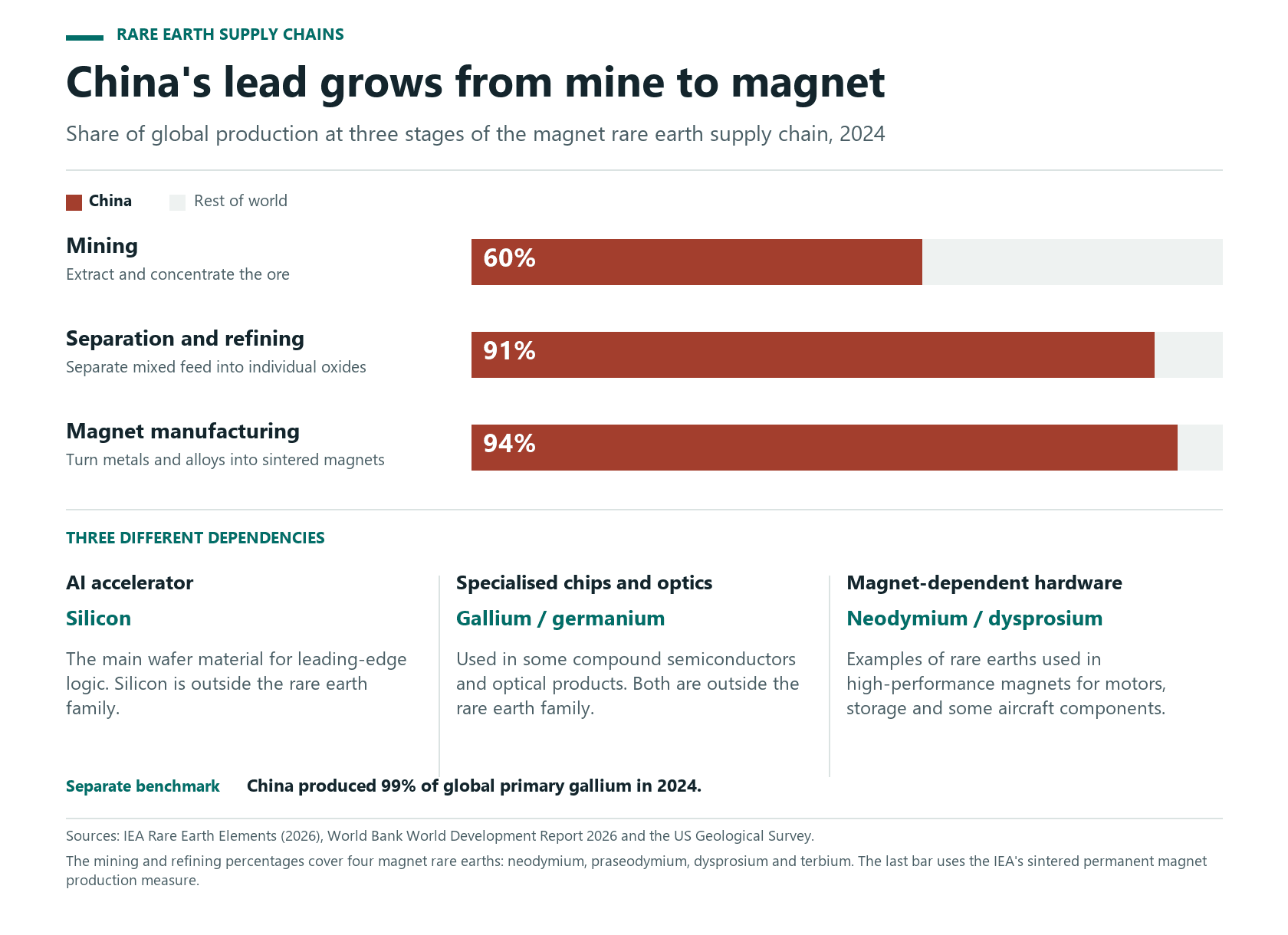
The AI agreement addresses a different supply chain. AI accelerators are built primarily on silicon wafers. Gallium and germanium serve specialized semiconductor and optical applications. Rare earths such as neodymium and dysprosium matter for high-performance magnets. Qatar already has exposure to the chip business. The Qatar Investment Authority backed Positron AI, which designs chips for running AI models, and Ooredoo offers computing on NVIDIA processors hosted in Qatar.
Where Qatar Can Take a Stake
U.S. Under Secretary of State Jacob Helberg linked the minerals deal to Pax Silica, the U.S.-led technology supply-chain initiative Qatar joined earlier. He described the framework’s scope in a post after the signing.
“This framework builds on that foundation to secure supply chains from mining to refining to manufacturing.”
Qatari money is already in the minerals business. Qatar-backed Cascade Natural Resources committed $165 million to Pensana and its subsidiaries to help develop Angola’s Longonjo rare earth project. Pensana reported receiving $15 million and gave Cascade more time. Longonjo would supply a mixed rare earth carbonate that still needs separation. The Qatar Investment Authority also committed $180 million to TechMet, a broader critical minerals investor backed by the U.S. International Development Finance Corporation. TechMet’s portfolio includes REEtec, which is building a separation plant in Norway.
The next investment could put Qatari capital into a separation plant or a facility that turns refined oxides into metals for magnet makers. A project with a secure source of raw material and long-term buyers has a clearer route to financing. The Pentagon’s deal with MP Materials shows what that can look like. It gave the company a 10-year price floor of $110 per kilogram for its neodymium-praseodymium products and guaranteed buyers for magnets from its planned Texas facility. Those terms give a new producer room to build capacity even if market prices fall.
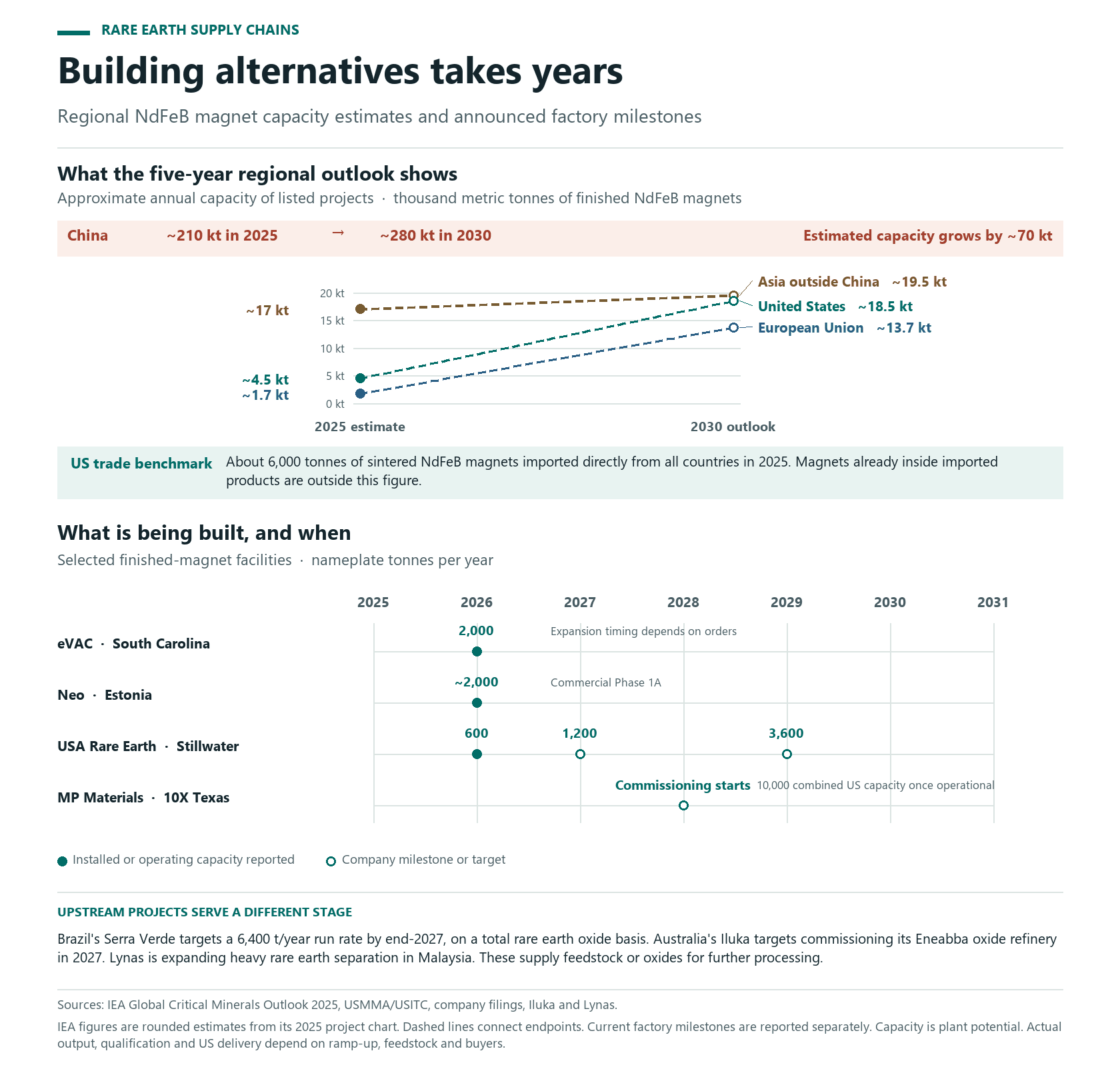
The IEA’s five-year project outlook puts U.S. capacity for neodymium-iron-boron magnets at about 18,500 metric tons a year at the end of the period, up from roughly 4,500. China’s capacity is projected to rise by about 70,000 tons over the same period. Some alternatives are already taking shape. eVAC has started commercial production in South Carolina, where its plant can make about 2,000 tons a year at full capacity. Plants like that still need processed material that meets their specifications.
Washington gets a partner in diversifying supply. Qatar gets a chance to own part of the capacity manufacturers will need to make that diversification work. The clearest sign of progress will be a funded plant, a dependable source of material and a buyer for what comes out of it.
Related Articles
Microsoft Brings Azure OpenAI Processing to Qatar’s Cloud Region
UAE Signs Declaration to Strengthen AI Supply-Chain Security
U.S. AI Chip Rules Tighten Overseas Access to Nvidia Computing